Monday, November 25, 2019

Happy Thanksgiving!

I'll be taking this week off to rest, give thanks, eat amazing food, and continue reading Michael Phillip's Hidden in Time!


You can come back next week for the conclusion to this series. Until then, have a wonderful Thanksgiving!!

Monday, November 18, 2019

The Livingstone Chronicles: Rift in Time

After learning about Jebel El Lawz and all of the historical findings there, I remembered a set of books I read years ago—that were still on my bookshelf: The Livingstone Chronicles by Michael Phillips.

This series follows world-renowned British archeologist and explorer Adam Livingstone on some daring discoveries and adventures. In fact, the first book, Rift in Time, opens with his discovery of Noah's Ark in Turkey's Ararat region (this isn't a spoiler... it says so on the cover, haha).


Published in 1997, I probably first read this book and its successor (see next post) in the early 2000s. So I didn't remember all of the details; just that it was about an archeologist looking for ancient Biblical things. 

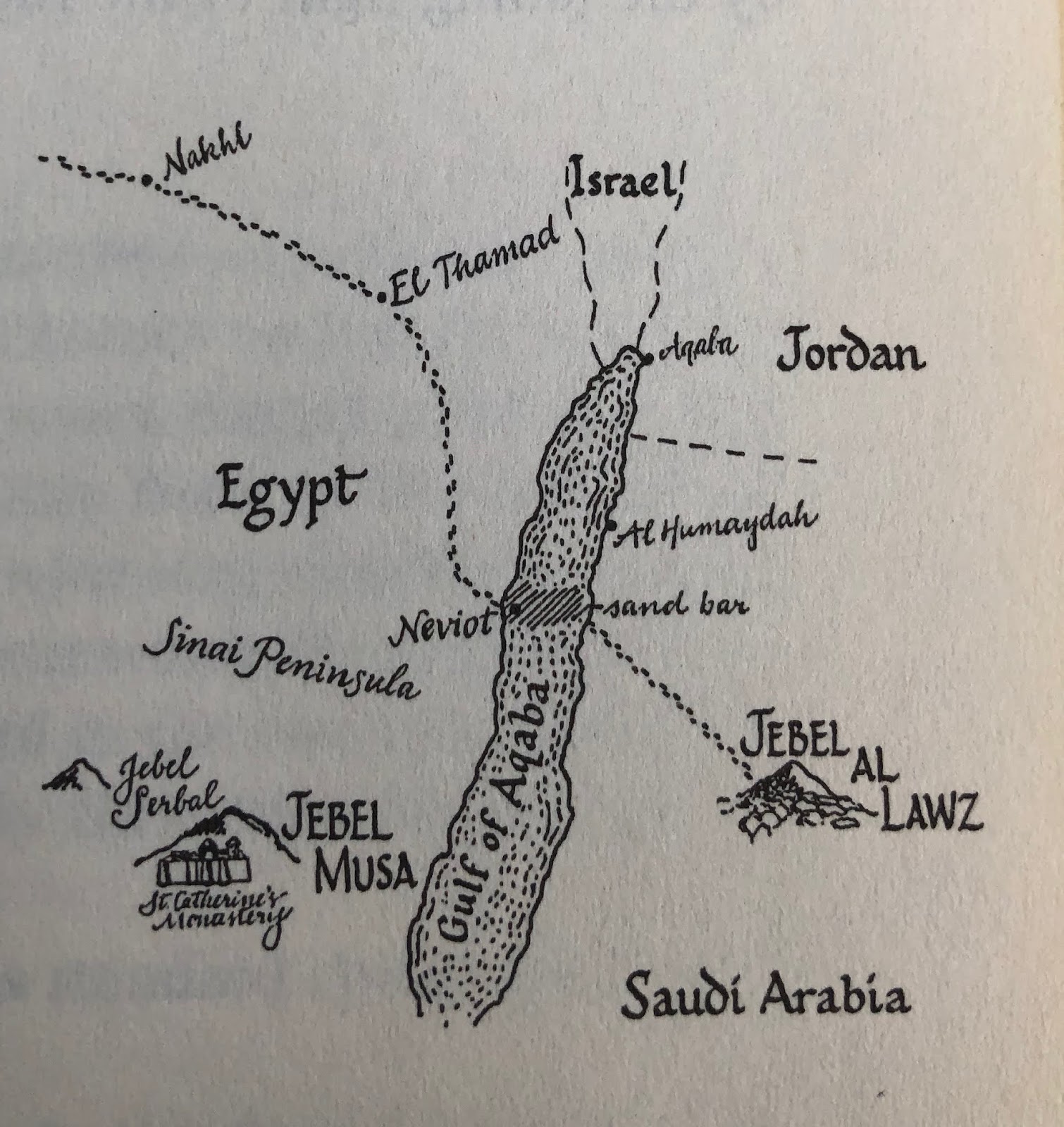
Imagine my shock when I re-read the book and realize that Livingstone and his crew travel to the Red Sea from Cairo, cross over by boat at the underwater land bridge of Nuweiba and head toward the mountain with the burned peak. They are in search of something other than Mount Sinai (I won't say what), but acknowledge that this is likely the place (even after acknowledging and glimpsing the traditional site of Mount St. Catherine's in Jordan), noting things of interest like a plain where people could camp, the fence keeping people out, the many caves in the area, and a split rock. 

Now that I have seen this documentary, I can see Livingstone, Rocky McCondy, and Juliet Halsey climbing to the peak of Mount Sinai and it's pretty cool. And throughout the books are drawings and maps - check this one out:


Wow!

Reading this books as a teen, I loved them because I love archeology, especially Biblical history, and adventure. I kept these books for almost 20 years for this reason, having read them at least 3 other times. But only just now was I able to "see" what the author was talking about. Pretty cool!

I definitely recommend this series (and hope to re-read and review book 2 next week), but I will say that it is written in the "Christian literature style of the 90s", so it's definitely different than the books out there today (pre-internet and shorter attention spans). I love it, even with all the commentary... that's why it's going BACK on my bookshelf!

Monday, November 11, 2019

Underwater Land Bridge for the Red Sea Crossing

For the last few weeks, we've been talking about the site of Jebel El Lawz in Saudi Arabia, and how it is likely the location for Mount Sinai instead of the traditional Mount St. Catherine's in Jordan.

Last week, I shared an INCREDIBLE DOCUMENTARY of this site that has been hidden from public eye from the government of Saudi Arabia. In the middle of this documentary was something so fascinating that I wanted to come back to it.

One of the proofs Ryan Mauro mentions is an underwater land bridge called Nuweiba Land Path from Egypt to Saudi Arabia. The video shows the beach there of the Red Sea, and mentions the stories of interesting coral reefs... shaped like wagon wheels or parts of chariots... almost as if coral had formed around these objects, which had then disintegrated over the course of several millenia.


I actually don't know where this image above came from, because Mauro says that, this being a popular diving location, they wanted to dive and record these images themselves. But they weren't allowed to—the Saudi police showed up and didn't leave until Mauro and his crew left.

What do you think? This evidence contributes to the case of Mount Sinai being at Jebel El Lawz, as it is near this site. I'm fascinated and would love to learn more about this!


*Edited March 29, 2020: Last week, Amir Tsarfarti had a special update during this coronavirus quarantine. At minute 21:35, Tsarfarti actually speaks about this land bridge as the location for the Red Sea Crossing!


Monday, November 4, 2019

Mount Sinai in Saudi Arabia: MIND BLOWN

This series on Mount Sinai possibly being in Saudi Arabia is too fascinating (for me) to want to move on just yet.

So, I have one more goody to share with you, and it's a doozy!


Ryan Mauro—I have no idea who he is, but he has the official journalist's voice (do you take a class to learn that in school?) did a 25 minute documentary on it that I found on Fox News. It's amazing! Besides getting amazing footage, he shares more evidence than I shared yesterday, all evidence that lines up with the Biblical account, like:
  • from conversations with locals
  • to the possibly site of the Red Sea Crossing (where coral reefs grow in some pretty interesting shapes... as if they are around wheels or something, AND where there is an underground path from the other side in Egypt), 
  • to Elim, the oasis which still has 12 wells today
  • to the possible site of the altar with the golden calf
  • a massive ancient burial ground near the camp where all the graves were dug all at once (3,000 people were killed for worshipping the calf and would have needed to have been buried)
  • a structure that looks like an ancient altar (that Moses built with uncut stones and also placed 12 pillars). It leads to the place where it's believed animals would have been slaughtered for sacrifice... and remains of animals have been found below these rocks.
  • evidence of a stream that would have flowed down the mountain and near where the altar to the golden calf was (Moses threw its remains into the river), as well as a place where there were burnt sacrifices.
  • evidence of wells, where a pool of water would have formed... proving a large population once lived there.
  • The cave of Elijah, where he spoke with God, which is above where the altar was
  • The split rock, which Josephus said was still visible in his day (1st century AD) and was so big it could not have been moved.
  • The rocks underneath the split rock are smooth, as if water passed over them.
  • Hebrew inscriptions nearby with pretty strong evidence (too much for me to type here)
This Bible nerd is like 😱😱😱😱😱😱! Literally... in the middle of this, I went, "Holy cow"... and then realized what I said. 😂 My mind is completely blown, and I'm going to have to watch this like 20 more times.

Watch it for yourself—you won't regret it!


(A screenshot from the video. The 2 arrows - that I drew -  in the photo point to people. One is almost impossible to see because he's wearing khaki. The other is standing and wearing black by the side of a rock. That's how massive this rock is. It sits on a hill that is 100feet high, and the rock itself is between 40-50 feet, which a crack big enough for a grown man to fit inside).

MIND BLOWN

Monday, October 28, 2019

10 Reasons Why Mount Sinai Could be in Saudi Arabia

Last week, we talked about a possible site of Mount Sinai in Jordan, and the beginning of the story behind the 'discovery' of another location in Saudi Arabia.

Are you ready to see what they found?

1st: A mountain, in the location of Midian, which is in a foreign country to where Moses previously resided (not the Sinai Peninsula, because that was Egyptian-controlled territory, and therefore not foreign)

2nd: This mountain is located to several caves, known as "Jethro's caves" to the locals. Jethro was the name of Moses' father-in-law. Locals also refer to this mountain as the mountain of Moses.

3rd: Tracing Moses' path to this mountain, he would have passed Elim in Midian, a beautiful oasis with 12 wells where the Israelites stopped.

4th: Galatians 4:25 says that Mount Sinai was in Arabia, not Egyptian land.

5th: Artifacts, potsherds, and more, dating back to the time of Moses, were found there.

6th: There is also evidence from sources like Josephus and Ptolemy.

But this is what got me:

7th: This mountain, the highest mountain in Midian, has black peak, as if it has been burned. The burned part continues more than 200 feet. But it's interesting... the entire mountain isn't burned at the top... only the outside of the rocks. If you climb up, pick up a rock, and turn it over, it's a normal color on the bottom—not burned.

This is significant, because Exodus 19:18 says that Mount Sinai was completely enveloped in fire when God descended on it.

photo from here


8th: On the mountain is the cave believed to Elijah's cave

9th: Nearby is a rock that is 6-7 stories tall that has been split down the middle. Almost like... someone struck it with a rod and then water poured out.


from Fox News.

10th: The base of where the golden calf stood is still there, right in the viewline of Mount Sinai, AND, carved onto rocks of the encampment area (which, is large enough to have held the Israelites while they lived there for an entire year) are images like... calves...and people worshipping calves... and a menorah.

This would be the oldest image of the menorah found to date, which is a symbol of Israel. Teacher Amir Tsarfati with Behold Israel says the menorah is the main symbol for Israel, even moreso than the star of David (that's a post for another day).

And this is especially significant, because the first menorah was made here, at the foot of Mount Sinai, when the Israelites first received the instructions for the Tabernacle and completed them, creating the first menorah.

Only God really knows, but that's a lot of cool evidence. What do you think?

Monday, October 21, 2019

Could Mount Sinai be in Saudi Arabia?

So, there's a mountain in Jordan believed to be Mount Sinai. At the top is a monastery called St. Catherine. It's open to the public to either ride up or hike (which I understand is a serious #legday), and is an incredible experience.

However, it's not completely proven that this is the place of Mount Sinai (also known as Mount Horeb).

traditional site of Mount Sinai in Jordan


Recently, I heard about a place in Saudi Arabia, know as Jebel Al-Lawz.

Until recently, this mountain was closed to the public. It had a fence around it and was heavily guarded by the government. But this isn't true anymore! Saudi Arabia opened it up to tourists!

So, how are we aware of this place if until this month, we were unable to visit it and all photos were banned?

In 1984, Ron Wyatt was visiting Saudi Arabia, saw this place, and took pictures. Soon after, the fence went up around the mountain. He and his sons were accused of being spies and held as prisoners for 2 months, waiting for execution! During these 2 months, Dr. Wyatt helped a lot of prisoners. His guards saw this, began to talk with him, and he convinced him of his story. He was released but had to delete his pictures. He left, but not without telling his story to others.

Fast forward more than 20 years, and a man named Dr. Kim, who served the prince and king of Saudi Arabia for 15 years, was given a reward for his service. So he asked for permission to see Jebel Al-Lawz.

What he found stunned him—and he was allowed to take pictures!*

Stay tuned for more of this amazing story next week!

*story found here

Monday, October 14, 2019

Delilah: Treacherous Beauty

This week we're going to look at the final book in the A Dangerous Beauty series by Angela Hunt: Delilah: A Treacherous Beauty.


First of all, hello #coverlove. I can't stop looking at this cover, probably because it has my favorite colors.

Anywho, this book was interesting because it is a depiction of a woman we don't know that much about, something Hunt discusses in her author's note. We don't know that she was necessarily a Philistine, which raises some interesting questions for the author to explore in her depiction (she had Delilah being of Crete and Egyptian descent, living in Philistine-controlled Gaza.

Hunt's exploration of the reasons behind Delilah's betrayal of Samson is really well-written. As with all of her novels, the evidence of her research is clear throughout the novel (and there's a list of sources in the back). 

What I loved in this book was how Hunt focused on the cultural importance of family in the novel. By placing Delilah as not being from any of the local people as a contrast with Samson, who though Jewish, was set apart as a Nazarite, it drove home the importance of family as both community and identity in ancient Near Eastern culture. Ultimately, it was this conflict that drew the two of them together, the mutual feeling of isolation. It definitely gives a unique perspective on what could have happened!

You can find Delilah: Treacherous Beauty here on Amazon!

Monday, October 7, 2019

Bathsheba: Reluctant Beauty

This week, we're going to continue with Angela Hunt's A Dangerous Beauty series and talk about Bathsheba: Reluctant Beauty.


To be honest, I struggled with the beginning of this book. Since the events of the book aren't spoilers (they are in the Bible, haha), I'm not going to worry with hiding the events. I love Angela Hunt's books, especially her more contemporary settings like Unspoken, The Canopy, and The Justice. But because this is such a well-known story, Hunt took the risk of portraying the scene of David and Bathsheba in a very different way. At the end of the novel, she explains why—how traditional expositions of this story portray Bathsheba as a manipulative adulteress, and perhaps there was an unexplored angle here. I get that and respect it, but that doesn't mean that it wasn't difficult to read or that I agreed with the portrayal of what was essentially, rape. I also struggled with the early depiction of Nathan and how he dishonored his wife because of his lust for Bathsheba.

That being said, I believe she went farther into describing the culture and beliefs of this culture than many depictions of this story. It reminded me of Misreading Scripture with Western Eyes' exploration of the shame that David felt (and its reason), which I talked about here.


I still feel like the guilt portrayed here was more from Western eyes than Eastern, but it was closer to Eastern than I had read before. And perhaps my problems with the early scenes had more to do with my Western predisposition and cultural/personal bias. This book is well written, and Hunt expertly stayed true to the character development throughout.

In addition, I appreciated how she continued the story through those central scenes, so we could understand what is can be a confusing thread of scenes in the Old Testament. It was easier to see the connection between the consequences of this initial sin and how it impacted following generations.

Click here to purchase the book here on Amazon!

Monday, September 30, 2019

Hadassah: One Night with the King

In continuing with our series on Esther, we're going to look at another fictional retelling of her story: Tommy Tenney's Hadassah.

I first read this book in college, and loved it so much that I kept it. In fact, this is my favorite fictional re-telling of Esther's story. Upon re-reading it, I realized why. 

First of all, it starts off in a place I know well, which is always fun to discover. But more importantly, Tenney's insight into the character of Esther is so profound. His voice is beautiful, and he really takes the time to draw you into her heart and her view of the king. I love how she chose to approach the king, and the parallels Tenney draws between that and how we are to approach God's presence are powerful. 

As one character put it: "When you are in the presence of the King of Kings, destiny—not just your own, but the world's—can change in the twinkling of an eye" (page 78).

In addition, we're given even more insight in this book as to the history between Haman and the Jews, as Haman is an Amalekite. Tenney takes the reader through the line of 500 years and the consequences of Saul's sin of not executing every member of that nation as was commanded by God. 

In fact, this book was so well-received that it became a movie in 2006! Click here to see the movie, or to purchase the book on Amazon, click here!

Monday, September 23, 2019

Esther: Royal Beauty

Okay, we are switching back to Biblical fiction, this time with two different fictional retellings of Esther's story!

First, this week we'll look at Angela Hunt's Esther, the first in her A Dangerous Beauty series.


I'm a fan of Angela Hunt, and Esther is a favorite story of mine, so when I saw that this author and written a re-telling of this story, I had to check it out.

This story is told from 2 characters' viewpoints: Esther's (her Jewish name is Hadassah) and King Xerxes' chamberlain (eunuch), Harbonah. The reader is able to follow Hadassah's journey from a child to queen, while also reading from an "insider's" perspective through Harbonah.

It's a great retelling, and really takes the reader into Hadassah's world. I also loved the depiction of Haman. She wrote him to almost to be like Wormtongue in Tolkien's The Two Towers, in an ostentatious sort of way. You can definitely see this progression in Hunt's portrayal, and because of her deep dive into the characters' flaws and inner struggles, can understand better how it happened—which makes the victory at the end all the more incredible!

If you like the story of Esther, this is a great read. Click here to purchase on Amazon!

Monday, September 16, 2019

Walking in the Dust of Rabbi Jesus: Read this Book!

That's all for our series on Walking in the Dust of Rabbi Jesus by Lois Tverberg. I hope you enjoyed it!


There's so much truth and wisdom in this book that there was no way I could summarize it. I hope the topics we discussed interested you enough to get this book and do your own study! If you do, please let me know—I'd love to talk with you about it!

To buy it, check it out here on Amazon!

Monday, September 9, 2019

Honi and Chutzpah

In 2011, Mark Batterson published a book called, The Circle Maker. It took me a while to get around to reading it, mostly because it make instantly trendy (like The Prayer of Jabez years ago) and I sometimes find myself suspicious of things like this—how accurate are they? Are they just popular because of prosperity Gospel? What does the Bible really say?


However, after reading Lois Tverberg's chapter on chutzpah on in Walking in the Dust of Rabbi Jesus, I couldn't help think of this book. Of which... I don't remember much other than that it's based on the premise of the story of a Jewish who lived a century before Jesus named Honi. Apparently, Honi was a humble man who loved God. Once, during a severe drought, the people asked him to pray for rain.


So, Honi went out and drew a circle in the sand. He got in it and prayed for rain, ending with "I'm not leaving this circle until it rains!" 

And it began to rain, just gentle drops. And Honi said, "That's not what I wanted, but rain to fill cisterns, pits, and caverns". 

And it began to rain violently. "So again, he prayed, 'This is not what I wanted, but rain of goodwill, blessing, and graciousness.' Then it began in just the right way, nourishing crops and restoring the land. (page 124 of Walking in the Dust of Rabbi Jesus). 

I love that this story comes from the inter-Testamental period, the 400 years of silence between Malachi and the birth of Jesus in the Gospels, because it shows how there were those who truly loved God and remained faithful during that time. 

Honi is a great example of chutzpah. But while he definitely benefited from the rain as well, I love that this falls in line with Tverberg's principle of chutzpah often being for the sake of others. He wasn't praying rain for himself, but for the community that was suffering greatly and would continue to without it.

I asked this last week, but I'll ask it again. How can we pray with chutzpah for those around us?

Monday, September 2, 2019

Walking in the Dust of Rabbi Jesus: Chutzpah

In Chapter 9 of Walking in the Dust of Rabbi Jesus, Lois Tverberg talks about the Jewish concept of chutzpah.


Chutzpah is, in Tverberg's words, "utter nerve, sheer audacity, bordering on obnoxiousness" (page 118). She tells a story about elderly lady who boarded a bus she was on and sat down without paying. The driver asked where she was going, and the lady replied, but didn't get up to pay. Even though they were on the busiest street in rush hour in Jerusalem, the driver stopped, pulled out a newspaper, and waited for the woman to pay. Traffic came to a standstill and he refused to move. Eventually, the woman left the bus and the woman moved on.

Just summarizing the story above is making my heart race dangerously fast. Being from the South of the US, where you are always polite, don't make waves, etc., I'm stressed out just imagining this, haha. 

That woman had chutzpah—and Tverberg points out that it's part of the culture of the Bible as well. The first story she references with this is the story Jesus told of the Syrophoenician widow pleading with a judge for justice. She eventually wears him down and he decides to give her justice just so she'll go away. 

It's funny, because I used to cringe at that story for that reason. In my culture, it's rude and "wrong" to keep coming back after a "No". Imagine a child who wants ice cream before dinner, and the mom says "No", and the child keeps pleading, "Please, pleeeeeeeeeaaaasssseeeee, pleeeease!" (Even the thought of that makes me nervous!) I was taught, "No means no, don't keep asking." But there are so many stories in the Bible where people continue to plead with Him after a "No". 

Another example Tverberg gives is Abram 'bargaining' with God over not destroying Sodom and Gomorrah: "What if there are 50 righteous people? What if there are 45? But what about..." Even as a kid, I remember thinking, "Why does he keep going back at God like this? God could change His mind and say, '0, then, because you keep pushing it and pushing me.'" But as Tverberg points out, "Jesus liked a little chutzpah" (page 119), and then asks us the question that is the title of the chapter: 

What if we prayed with a little chutzpah? The point faith we're supposed to have is not supposed to be in the outcome, but in God Himself. What do our prayers reveal about what we believe about God?

Before moving on, I do want to say that Tverberg also talks about the danger of prosperity Gospel or "name it and claim it" theology. She says that most often the difference is the Jewish attitude of chutzpah in prayer is not for oneself, but on behalf of others (page 127). That's going to be really important to think about in my next post. But until then...

How can we pray with chutzpah for others? How does this concept widen our perspective on certain stories we've maybe ready a hundred times?