Showing posts with label Susita National Park. Show all posts

Sunday, November 13, 2022

The Golan: Peace Vista (Part 3 of 4)

Driving south along the Golan, past the entrance to Gamla National Park and you'll find the Kfar Haruv Kibbutz and one of the most spectacular views of the Sea of Galilee that I've never seen: The Peace Vista.


It was windy that day we were up here, but I was so glad for that because it was late June and a documented 103 degrees Fahrenheit. The view did not disappoint!


It was so vast (and we were so close) that I couldn't fit the whole lake in the photo. WOW! 


Built on the stones of a 1,700 Talmudic village, the view point offers and incredible view to not only appreciate the beauty of the area but also to understand its history. From above, you can see much of the Golan. And if you're with a tour guide like I was, from there, you get to get about the history of the area, most recently in the Six Day War of 1967, with him pointing to and fro.

And, there was a bonus. It's hard to tell unless you zoom in, but beyond the taller trees on the mid-right of the photo is a ridge and some more ruins: Susita (Hippos)! You can almost see Kursi National Park as well. So cool!

Shalom for Israel, Shalom for Jerusalem, Shalom for all.

Monday, October 24, 2022

The last thing I expected to see at Caesarea Philippi

Caesarea Philippi is known for being the place in Matthew 16 where Peter says to Jesus, "You are the Christ (Messiah), the Son of the Living God".

In this region is this mountain and cave where the headwaters of the Hermon Stream (from Mount Hermon) flow out of the ground and form part of the headwaters of the Jordan River. 


What I learned on this visit there, that differs from my tour in 2017, is that while Peter said this to Jesus in this area, it's unlikely he said it right here at this cave. 

Why?

Because it's a place of pagan idolatry, and Jews would not have gone there. Jesus didn't need to—everyone know about this place, this rock. His play on words, "Upon this rock I will build my church" still makes sense whether or not Jesus was standing there. 

While today the cave is closed up (though still deep), back in the day, this is where the water flowed from—just like the spring where Gideon's men drank. It's was so deep they couldn't find the bottom, and it was believed that this was the gate to the underworld.

Next to this cave were temples to the pagan god Pan. People worshipped here, did vile acts, and sacrifices were made in this stream. This site says that children were thrown in; we know for a fact that goats were too. If the goats sank, then the sacrifice was accepted.

In 749 AD, the same earthquake that destroyed Beit She'an, Susita, and so many other places in Israel, also destroyed this place. At that point, the cave was closed in and the springs found a place farther south to stream from the rock.

The last time I visited this site, this is basically all I saw, along with more statues/pillars. So I was unprepared for the latest excavations:


It turns out that Augustus Caesar gave this town to Herod, who turned around and built a marble temple for Caesar in front of the cave. About 5 centuries later, a church was built right over those ruins.


Something that is very common in Israel that is that any place where it's documented that Jesus said or did something, the Catholic, Greek Orthodox, or another liturgical church came later and built a church there. So, I guess it shouldn't be that surprising—but I was only here 5 years ago and those ruins had not been excavated then! So that definitely shocked me.

It's also surprising to me, to see a church here at a place of pagan worship, even if Jesus did say that statement nearby (or right there). But, there you go... can't argue with proven fact. 

What do you think of this?

Monday, September 5, 2022

Beit She'an: Trapped in Time

Beit She’an is one of those places that I knew was cool when I visited in 2017, but was unable to fully grasp just how incredible it was. I think I was on overload at the time.

So when I went back, I got to be amazed all over again!


One of the 2 cities of the Decapolis as mentioned in the NT that is in Israel (the other being Susita in the Galilee), Beit She’an was a thriving Roman city during Jesus’ day. It was built at the foot of a tel dating back millennia- the same place where the Philistines hung the headless bodies of King Saul and his sons over the walls (1 Samuel 31:8-13). From a theater to a bathhouse and public toilets, this place had it all.

The bathhouse:


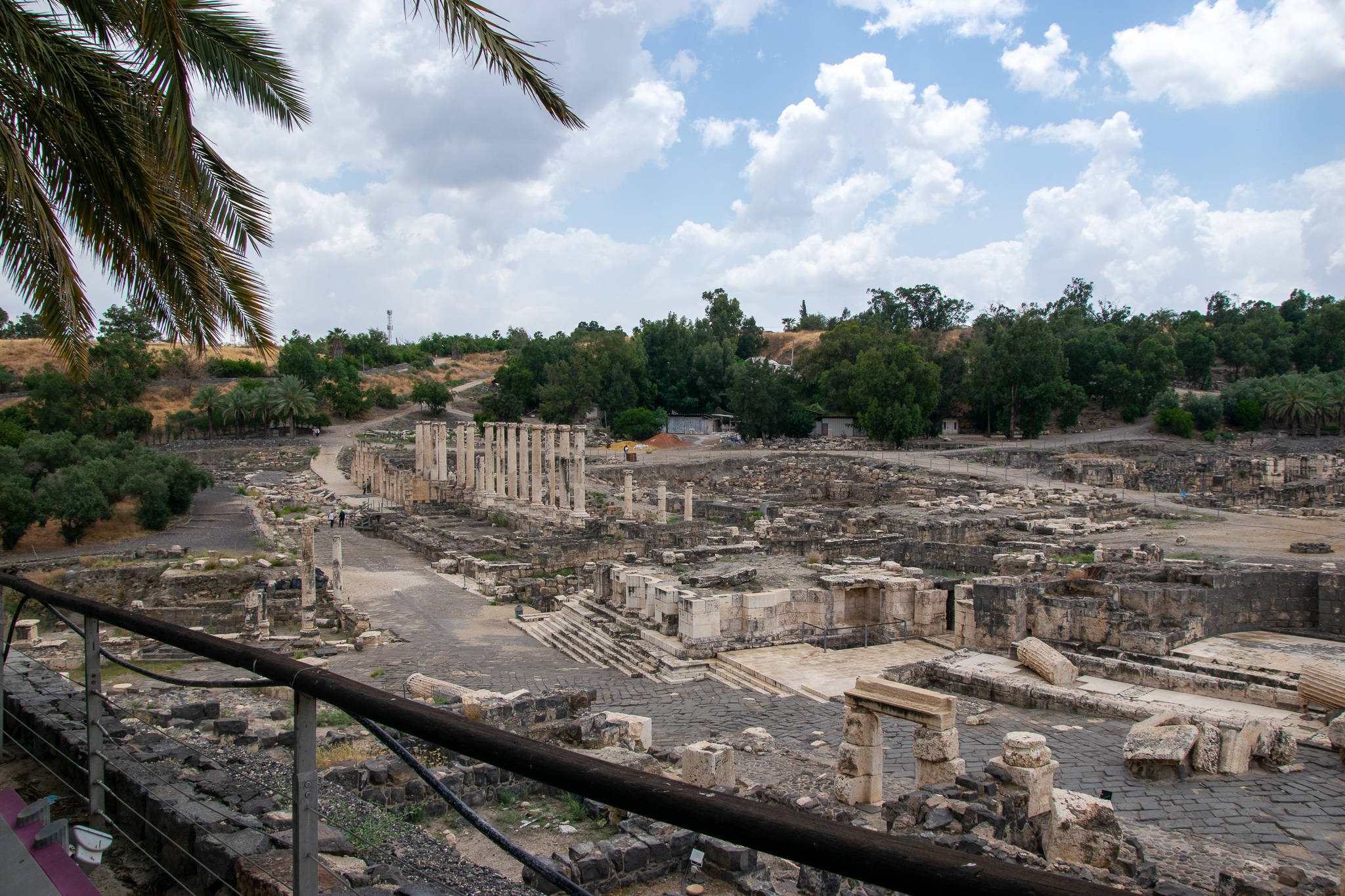
View from the main street (cardo):

The cardo, or the main street going through the center of town:


The statues here show at least 1 thing this city was known for...


Until 749 AD, when a massive earthquake shook the entire region- the largest in recorded history. All this splendor fell down and cracked open, stately columns rolling this way and that until they finally stopped laid in testament to the tectonic game of pick-up sticks the earth played on that fateful day. When the city was found and excavated, coins dating to 749 AD were found, marking the exact date of destruction almost as well as a stopped clock.


These columns are massive... grown men can't wrap their arms around them.


Once again, I went up to the top of the tel. The view was stunning!


On a clear day, you can see all the way into Jordan from the other side:


At the top of the tel lie more ruins, this time of the Philistine village. But, they dug deeper and even found the governor’s house from when the Egyptians controlled the area! That’s MILENNIA ago!


WOW! If you ever get a chance to visit Beit She'an, I highly recommend it! The magnitude of it is overwhelming.

Sunday, January 30, 2022

Where Jesus sent the demons into the pigs

When I saw Kursi National Park on Google Maps while I was in the Galilee, I thought it just had some cool ruins of an old church. I didn't think it was a Biblical site.


And to be fair, these ruins really are cool, mostly because I love arches. And some of the original floors from this church from the 5th century. 


I mean, who doesn't love original floors?


But what I didn't realize until I started exploring is that this national park is in the Gerasenes, where, in Mark 5:1-20, Jesus healed the demoniac and sent the demons into the herd of pigs, who then ran over the cliff. 

The freed man then went into the area of the Decapolis to tell of what Jesus had done). I checked googlemaps, and Beit She'an is actually pretty far from there...almost 40 minutes driving. But Mark's account speaks of the local people being angry and afraid, telling Jesus to leave the area, and Jesus telling the man to go far away. So maybe he went to the city of the Decapolis that is at the foot of Beit She'an. It's also likely he went to Susita (Hippos), which was also one of the 10 cities of the Decapolis. That is closer to Kursi National Park, and I hope to go there soon).

Either way, this is the traditional location of that cliff! 


As I've said before, the Sea of Galilee has shrunk a lot over the years. Right now it's about 13 miles long and 7 miles wide at its widest point. There's actually a trail that goes up from the left to just before the actual cliff face, and the remains of an old chapel are there as well.

The cliff from directly below it:
The location of the water makes it reasonable to think that it could have touched the edge of this mountain, as the Sea of Galilee has shrunk a lot since the first century.


So fun!!!

Monday, August 21, 2017

Beit She'an

The ancient Roman ruins at the foot of the hill is Decapolis, a city mentioned several times in the New Testament. When Jesus sent the demons from the possessed man into the pigs, the man then went to Decapolis and told people what Jesus had done (Mark 5:20), and also where Jesus healed a deaf and mute man (Mark 7:31).


The mountain beyond it contains the ruins of a Philistine settlement, Beit She'an. When the Israelites lost the battle with them on Mount Gilead (not pictured), King Saul fell on his sword (and his sons also died; 1 Samuel 31). The Philistines decapitated Saul's body, and then took his head, body, and his sons' bodies back to their city to hang them over the walls (on the mountain).


While we walked through the ruins, I kept eyeing the mountain, wanting to climb the steps to the top (right side). Finally the 2 teens on our trip asked the tour guide if they could, and I took off after them - in a skirt and flip flops. The view from the top was totally worth it!  #israel #apictureadayofIsrael #legday


ancient Roman public toilet