Showing posts with label Shefelah. Show all posts

Monday, October 2, 2023

Where God made the sun stand still

I was unprepared for Tel Gezer.

The contrasts of Israel often take my breath away: the juxtaposition of the ancient and modern side-by-side, never more than a few feet (and millennia) apart... like watching children skip over the ruins of an ancient city while a modern one looks on half a mile away, or a family picnicking where a battle once took place.


What I knew about Tel Gezer before going was simple: as one of the places Solomon fortified, it is one of the remaining trio of cities with its iconic gates. I’ve been to the other 2, Megiddo and Hatzor; this was my chance to “collect all 3.”

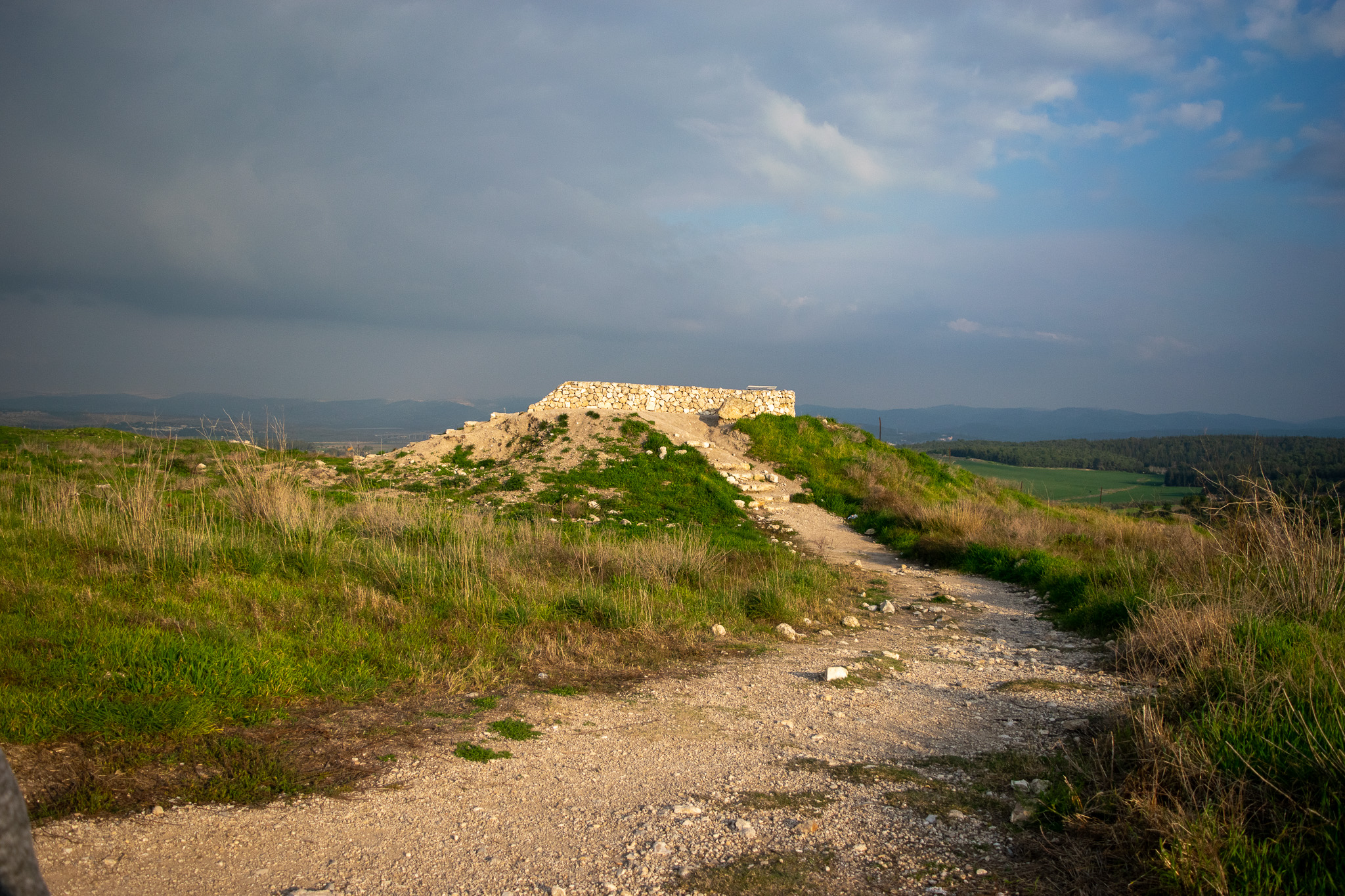
What I didn’t know was that Tel Gezer overlooks the Valley on Ayalon, where God made the sun stand still for the battle in Joshua 10. The valley itself is huge; here are the views in each direction:


EPIC.
As sunset neared and turned the valley pink behind us, we walked back to the parking lot, passing these stone monuments.


These stones mark a place of ancient Canaanite worship. The soil below them has been tested, and the remains of burned infants had been found there, evidence of ancient child sacrifice to pagan gods.


I’d never been to a place like that, and, in the shock and the sorrow of the moment, I was struck again by another juxtaposition: how unimaginable it was to witness this place of sorrow at all, let alone maybe a mile from where the Creator of those infants made the very sun stay still in the sky.

It’s another contrast I’ll never forget.

What made it even more sobering was that the sign marking the monuments said nothing about the infant sacrifice that happened there. And nearby, a group of women sat in a circle. When one of my tour guides went to talk with them, they told her that this was a place of worship for femininity and fertility, and they were there to connect with each other and this place. They had no idea about the real truth of this place.


Monday, September 25, 2023

Tel Gezer: Watch out for bats!

What do you know about Tel Gezer?

Tel Gezer lies in central Israel, south of Tel Aviv and west of Jerusalem. A major biblical city that was conquered by Joshua (Joshua 10), given to the Levites, and fortified by Solomon in 1 Kings 9 after it was given to him as a wedding present from Pharaoh, its ruins date back to the Bronze Age and including civilizations like the Canaanites, Israelites, Assyrians, Babylonians, Persians, Greeks, and Romans.


There's so much here in this park that we're going to explore in 2 posts. First, the ruins!


We first come to the Canaanite tower, which is close to the city gates. What's interesting here is how far down the archeologists had to dig just to get to it! Can you see the contrast from the tower remains to the height of the wall directly behind it?


Above is the remains of the tower. 

Next to it is the water system. I was going to go down there and then I heard that one was in fact full of bats- more than 1 million!- and my tour guide said: "Remember, 1 million bats = a lot of poop." I said, "That's okay, I'll take a picture of the entrance, haha."


From there, you go around to the Canaanite Gate:


Made of mud, I can't help but think of the 4,000-year-old gate at Tel Dan. Remember how well preserved it is? This one is not as well preserved.


But, can you see the mud bricks that still remain? How cool is that?

From here, you go up the hill and can see the ancient Solomonic-era city, complete with its city gates—the same ones that match Megiddo and Hazor!


The views to the valley beyond are beautiful. On the opposite hill you can see the caves mentioned where the kings of the conquered cities were buried in Joshua.


The 6-chambered Solomonic Gate!


In these photos, you can see the walls of the city are actually double-walls, with a chamber between them. It reminded me of Masada, where the families of the warriors were right there in the room with them. 


What was cool about this part were the families picnicking near the ruins. Children were exploring, walking around the walls and jumping between rocks. It's so mind-boggling to see ancient and modern side-by-side, and such a picture of how time moves on.

That's it for part 1 of Tel Gezer. Next week's post is about the most powerful part of the visit for me. See you then!

Tuesday, September 12, 2023

Where God gave victory over 1 MILLION Cushites

It's not everyday you learn about a Bible story while seeing the exact place it happened!

My favorite part of Bet Guvrin/Maresha National Park was the ancient tel of Maresha. It wasn't a name I knew of from the Bible, and while I have read its story several times in the past, I didn't remember it. So it was like I was experiencing the story for the first time!


Settled in Joshua 15, the city was fortified by King Rehoboam in 2 Chronicles 11: 5-8. Today, the path at the top is actually not solely the chalky limestone the area is famous for, but the top of walls of the ancient city. On this beautiful spring-like day, the Judean hills glowed green, with bright red anemones waving at the sky, and the sun gave views that took my breath away.


The path below is not sand; its the top of the ancient city walls that Rehoboam fortified!


Then, came King Asa.

The year was 900 BC, and 2 Chronicles 14 tells the story of the son of Shishak in Cush (Ethiopia) sending an army of 1 MILLION Cushites (Ethiopians) against Judah. 


King Asa rode out to a valley in the lower Judean hills with an army of 580,000 and their chariots. Asa cried out to God and said, "'Lord, there is no one like you to help the powerless against the mighty. Help us, Lord our God, for ewe rely on you, and in your name we have come against this vast army. Lord, you are our God; do not let mere mortals prevail against you'"

The LORD struck down the Cushites before Asa and Juda. The Cushites fled, and Asa and his army pursued them as far as Gerar. Such a great number of Cushites fell that they could not recover; they were crushed before the LORD and his forces. The men of Judah carried off a large amount of plunder."

WOW! And, when you are standing on top of tel Maresha, the only place in the area where this could have happened is this one clearing below.


I have to say, sitting on top of that tel, walking on its walls, then hearing the reading of this story while looking at the valley and the beautiful Judean hills in a 360-degree view is can only be summed up in 1 word:

EPIC.

Next week, we'll talk about what's at the base of this tel!

Sunday, August 20, 2023

A whole new (underground) world!

Caves, caves, and more caves!

When I think of Bet Guvrin, that's first what comes to mind. But there's so much more to this park. It's HUGE and will be a 4-part series probably. 

But today, CAVES!


There are so many caves carved in this area because of the rocks in the region are soft and chalk-like. It's this beautiful, creamy color and easy to quarry. So in this park are MANY caves that served as dove-cotes, quarries, cisterns, storerooms, tombs, and storage chambers. One of the caves was basically a maze, which I couldn't document clearly because you can't see the change of directions in a still photo. But it was A-MAZE-ING!!!

My favorites, though, were the Bell Caves. These bell-shaped caves were formed by quarrying in the Byzantine and Early Muslim periods. Their shape and the different colors of the earth, in addition to the light coming from the top, make them an incredible sight. Today, they are tourist attractions and also places for events like weddings and concerts. Can you imagine?!?

Also, I definitely heard bats in here. No, gracias!


This bedrock here (darker spot below) was about 20 feet off the ground, and it shows a closed off tunnel from the Bar Kochba Revolt (135-137 AD)! WOW!

The quarry:


But that's not the only kind of cave in Bet Guvrin. Here is the Polish cave. It originally a cistern that also doubled as a dovecote. It was given this name because of an inscription on a stone inside. During WWII, Polish soldiers visited the cave and carved an eagle, 1943, and Warsaw, Poland on the rock: 


Then, there's the Columbarium. This cross-shaped cave was also a dove-cote that held more than 2,000 birds! Being so close to Jerusalem, these were likely raised for sacrifices, as well as being used for food and their droppings for fertilizer. There are over 85 dove-cote caves found in the area of Maresha alone with 10s of thousands of niches!

This photo is an example of the soft, chalk-like rock the caves are carved from:


Then, a cave with an ancient oil press:


Finally, a Sidonian tomb! The artwork in here was so unique (and interesting). The animals had almost human-like faces.


Those are just a few of the caves in this 1,250 acre park. It's too much to see in a few hours. I definitely need to go back and spend more time there!