Showing posts with label Philistines. Show all posts

Monday, May 29, 2023

The chilling story of Lachish

I don't know how to tell Lachish's story.

It was a place I didn't know a lot about, and learning it as I toured it was powerful beyond words.


The 2nd most important fortified city of Judea, Lachish guarded a main trade road from Egypt to Jerusalem.

Canaanite Period:

This city dates back to before the Canaanites. At some point it was conquered by Egypt, and then possibly the Israelites or the Philistines. Its first mention in the Bible is in Joshua 10, as one of the Canaanite cities who came against Joshua at Ai. The Biblical account says Joshua chased the 5 kings of Amorites, including the King of Lachish, to Azekah (which overlooks the Valley of Elah, where David would slay Goliath centuries later). God delivered Lachish to Israel. It became part of the tribe of Judah’s land and the city was 2nd only to Jerusalem.

Israelite Period:

During the Israelite period, it held a strong position in defending the western frontier of Judea against the Philistines. King Solomon's son, King Rehoboam, fortified it in 2 Chronicles 11, and King Amaziah fled there for refuge in 767 BC (2 Kings 14, 2 Chronicles 25) after the Northern Kingdom was defeated by the Assyrians.

Assyrian Period:

Then came the Assyrian invasion in 732 BC. In all, Sennacherib, the general of the Assyrians, conquered 46 cities of Judea, and Lachish was the 2nd-to-last.


2 Chronicles 32 says that in 701 BC, during the time of King Hezekiah, the Assyrian army camped nearby,
seige to it, and built a ramp—a predecessor for the ramp at Masada- allowing then to breach the walls, taking the inhabitants into captivity. A chilling letter talks of the signal fires of Tel Azekah going out, meaning they were the last 2 cities left.


At this point in hearing the story, I had a picture of the beacons of Gondor being lit in Return of the King (Lord of the Rings), except opposite.
Can you imagine knowing the most vicious, powerful, and cruel army of your day is methodically making its way through your country, has conquered every city its encountered, and now the city closest to you, the lights you are supposed to watch, have now been extinguished?

Which means... you are next.

Today, in the British museum, is a relief that was found in Ninevah depicting this victory.


As we know, the Assyrian invasion ended not long after. God spared Jerusalem, and Lachish was rebuilt in Josiah's time.

Then came the Babylonians.

Babylonian Period:

They reached the gates of Jerusalem in 598 B.C. and placed it under seige (2 Kings 24). King Jehoiakim was murdered, and all of the nobles were exiled (including the son of King Johoiakim), all of Jerusalem excepted the poorest of the land were carried away into captivity to Babylon.

Nebuchadnezzar appointed Johoiakim as king and changed his name to Zedekiah. In 589 BC, King Zedekiah mutinied, and Babylon invaded again. This time it leveled most of the cities of Judah (Jeremiah 34). After Azekah fell, Lachish did, and then finally, Jerusalem on Tisha B'Av, 586 BC.

Persian Period
70 years later, when the exiles were allowed to return, Lachish was one of the cities that were reconstructed (Nehemiah 11). It eventually fell into ruin and was abandoned by the time of Jesus.


Today, you can walk around the top of this incredible tel, thru a gate dating back to Hezekiah, see the remains of the palace, along with a model of chairs to show the length of the reigns of Judah’s kings (we'll see that on next week's post!). On a beautiful winter’s eve, you can see the moon rise as the setting sun lights of the Judean hills in the distance- pointing the way to Jerusalem.


*some information from BibleWalks

Monday, May 22, 2023

Reading the Bible with GPS

As if seeing where David killed Goliath wasn't enough, that’s not all you can see at Tel Azekah.

There are current excavations for the ancient city mentioned in Joshua 10. I thought I saw an ancient toilet, but turns out t was a stone with a hole cut out to hld a pole. The tel itself is covered in pine trees, which makes this Georgia girl’s heart so happy, especially on a clear, beautiful day in December.


At the base of the tel are fragments of pottery that are free to visitors to take.


And last but not least, on the other side of the tel is a view of Gath, the Philistine city and Goliath’s hometown (it’s the brown hill in the distance), which means you can do fun things like track the Philistines’ and Israelites’ movements on googlemaps, if you’d like.


And, before you ask, of course I did that! The best part of being in Israel is that you can read the Bible with GPS! Doing so has given me extra insight on stories I've heard my whole life. I 100% recommend it—as I do going to Tel Azekah!

Monday, May 15, 2023

This is where David Killed Goliath; need I say more?

One of the first Bible stories you’re taught as a child is David and Goliath: the shepherd-poet-turned-giant-slayer-man-after-God’s-own-heart-and-the-2nd-king-of-Israel against an over 9-foot tall guy from Gath (descendent of the Nephilim?). I've heard this story all of my life. Its picture has made it into many sermons and analogies throughout time. It's so commonplace it gets intermixed with cultural lore and mythologies we hear all of the time.

Except, this story is real.

And nothing prepares you for the moment you see where it happened.

When I realized I could go to the very place where David slew Goliath, I looked forward to it for months. I was such a nerd about it and didn't care. This was a big one!

And, there it then there it was: the Valley of Elah.


1 Samuel 17 describes the scene: 2 hills with a small valley between them. The Israelites camped on the right side of those hills and the Philistines on the left, and the battle happened in the small valley between them.

Can you picture it?

The stream David gathered stones from ran along the valley, following the line of the current highway, before turning to enter the valley itself.

At the top of one of those hills are some ruins, but you need 4-wheel drive to get up there. From Tel Azekah, you can see the valley from above while your tour guide reads the story for you. It’s so real that for a second, you see the slight frame of a 16-year-old boy entering the valley in your mind’s eye.

Epic doesn't begin to describe it.

Israeli influencers Sergio and Rhoda went there in 2021, and I watched the video after visiting myself (I always need to visit before watching or reading about a place!). I loved that they did, because they tested the sound, tried out a sling, and looked for the stream. It's such a good adventure that I wanted to share it here:


If you watch it, let me know what you think!

I'd love to go back to the Valley of Elah one day and do the 4-wheeling tour up to the ruins, maybe run around below and search for the stream. What an incredible place!

Monday, April 17, 2023

Did the Ark of the Covenant rest here?

The thing about being in Israel is that you never know when you will see or learn something that will take your breath away. Tel Beit Shemesh definitely was one of those places!

In 1 Samuel, the Ark of the Covenant was stolen from Shiloh by the Philistines, where it began a tour of the major Philistine cities, as crazy things happened wherever the Ark was: statues of false gods fell over face first, decapitated and missing limbs, and all the people broke out in tumors to name a few. Eventually, the Ark was put on a cart led by two nursing cows, and they carried it out of Philistine territory to Beit Shemesh, where the Ark was eventually placed on a large stone.

Then, more tragedy struck. Because some Levites peered into the Ark, people died. Different versions of 1 Samuel 6 are unclear; some say it was 70 people and some say it was 50,070. The text also doesn't say how long the Ark was actually in Beit Shemesh, which means "House of the Sun". Either way, it was a hard-learned lesson.


Modern day Tel Beit Shemesh isn’t a national park; we literally parked on the side of the road and walked up, where we could see the modern city (below), and


and even glimpse Samson’s hometown (the far right peak in the distance).


There are ruins of a monastery, an amazing view towards the ancient Philistine territory, and a massive, cross-shaped cistern dating back to the Assyrian invasion.

But the coolest part is this place in the oldest part of the ruins dating to the Canaanite era, with the fields just beyond them. There are 3 flat, smooth rocks partially covered by grass in the photo below. They look a lot like places where sacrifices have been made, and tests of the ground around it reveal the remains of kosher animals used in sacrifices.


the 3 flat stones with the groove are in the center below, partially hidden by grass:


Behind those 3 stones is an unnatural wall, called “fill”. It was left after digging around it and now it acts as a wall, showing what the earth absorbed over the past millennia. On the edge of the “wall”, a bone is sticking out. Can you see it?

Can you see it?


We even found an animal bone lying just off the path where we were staying (bonus).

And behind that fill “wall”, is an even larger stone, also partially hidden in long grass. It’s flat, smooth, and almost the exact shape and size of what the stone holding the Ark needed to be.

Could that be where the Ark rested after returning from the Philistines?


I was pretty much speechless at that point, to be standing in this unprotected place, looking at a place that likely held the presence of God (as if He can be contained). Then it struck me, as incredible as that was, and is, even more so is that those of us who know Him have His Holy Spirit inside of us.

What a special place! The end of 1 Samuel says that after this, the Ark went to Kiriath Jearim, where it stayed in the house of Abinadab for 20 years.

Sunday, September 25, 2022

Mount Gilboa: Where King Saul died

And now we've come to Mount Gilboa, where Saul, Israel's first king, and his sons died. 


Or rather, the view from this mountain. It's likely Saul and his sons were killed closer to the base of it. And then, of course, their headless bodies were carried back to Beit She'an and hung from the city gates (of the town on top of the tel).


Do you remember why this mountain is barren?


In 2 Samuel 1, David cursed it for being the place where Israel's first king died. More than 3 millennia later, except for a patch where the Jewish National Fund planted some trees, the mountain is still bare.


Now, it's a place for people to come and hang out, picnic, and even hang glide over the Jezreel Valley. There are kibbutzim at the base of it, and hiking trails up to the place called "Saul's Shoulder".

WOW! Definitely a surreal place to visit in the Jezreel Valley.

Monday, September 5, 2022

Beit She'an: Trapped in Time

Beit She’an is one of those places that I knew was cool when I visited in 2017, but was unable to fully grasp just how incredible it was. I think I was on overload at the time.

So when I went back, I got to be amazed all over again!


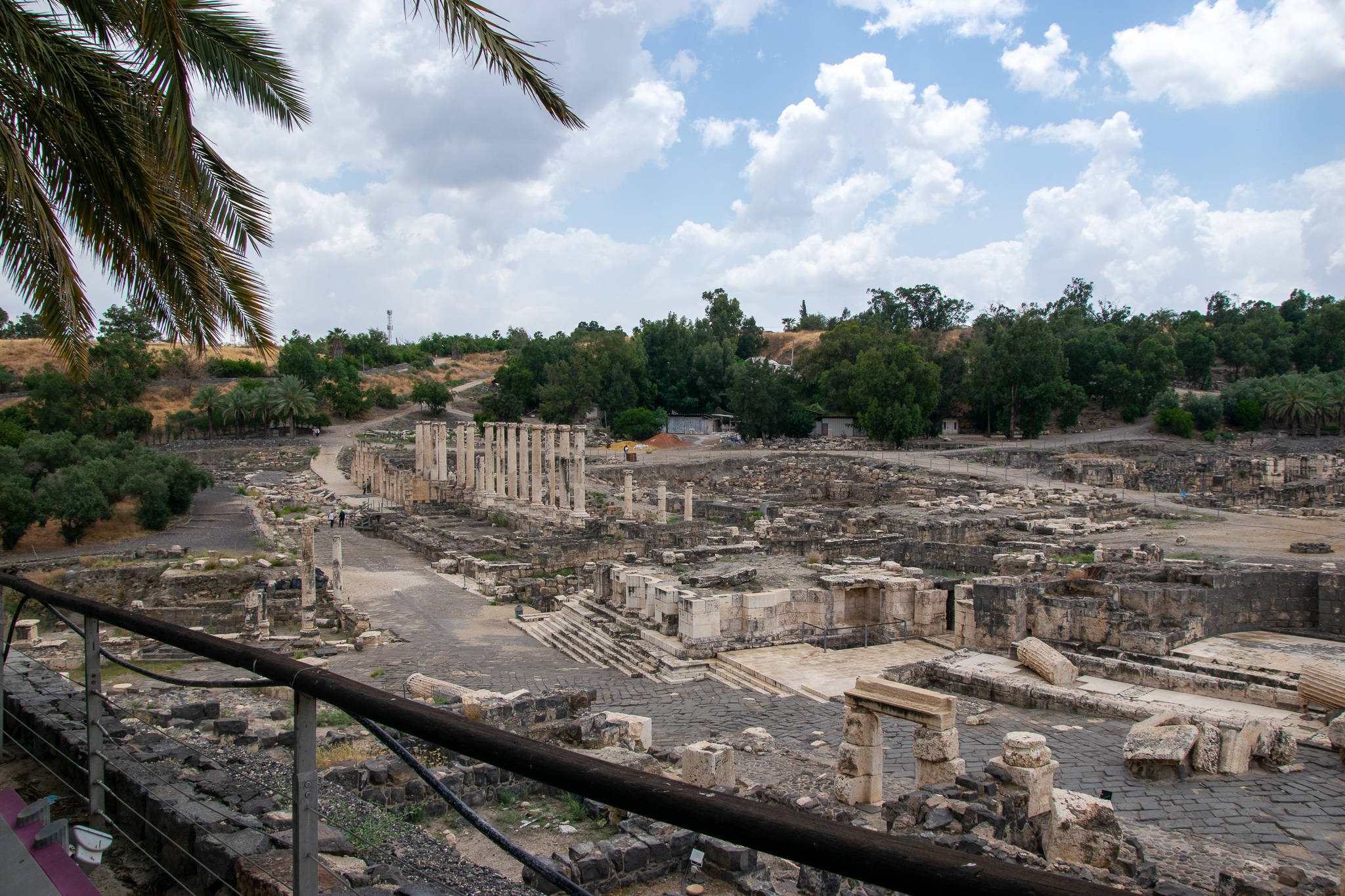
One of the 2 cities of the Decapolis as mentioned in the NT that is in Israel (the other being Susita in the Galilee), Beit She’an was a thriving Roman city during Jesus’ day. It was built at the foot of a tel dating back millennia- the same place where the Philistines hung the headless bodies of King Saul and his sons over the walls (1 Samuel 31:8-13). From a theater to a bathhouse and public toilets, this place had it all.

The bathhouse:


View from the main street (cardo):

The cardo, or the main street going through the center of town:


The statues here show at least 1 thing this city was known for...


Until 749 AD, when a massive earthquake shook the entire region- the largest in recorded history. All this splendor fell down and cracked open, stately columns rolling this way and that until they finally stopped laid in testament to the tectonic game of pick-up sticks the earth played on that fateful day. When the city was found and excavated, coins dating to 749 AD were found, marking the exact date of destruction almost as well as a stopped clock.


These columns are massive... grown men can't wrap their arms around them.


Once again, I went up to the top of the tel. The view was stunning!


On a clear day, you can see all the way into Jordan from the other side:


At the top of the tel lie more ruins, this time of the Philistine village. But, they dug deeper and even found the governor’s house from when the Egyptians controlled the area! That’s MILENNIA ago!


WOW! If you ever get a chance to visit Beit She'an, I highly recommend it! The magnitude of it is overwhelming.