Showing posts with label Constantine. Show all posts

Monday, March 28, 2022

Zippori: The Jewel of the Galilee

During the time of Herod the Great, Zippori (Tzipori/Sepphoris), located not far from Nazareth, was the capital of the Galilee.


It was a city of great wealth, surrounded by the fertile fields of the lower Galilee. It got its name from a bird that perches on top of a mountain, because that's what it looked it. While ownership of the city passed back and forth from the Greeks to the Romans to the Jews, it was back in the hands of the Romans by the time of Constantine, and in 363 AD, was completely destroyed in an earthquake.

But let's back up a minute. In 47 BC, Herod the Great became the governor of the Galilee and took Zippori by force. After his death in 4 BC, the Jews there revolted. The Roman army burned the city to the ground, put out the rebellion, and sold the Jews into slavery. Then Herod's son, Antipas, rebuilt and fortified Zippori, or, as it is better known in the Bible, Sepphoris. 

This is significant because Zippori is only a few miles from Nazareth, and after a city has been burned to the ground, the need for skilled craftsmen like carpenters and stone masons would be great. A famous carpenter/stone mason and his son from Nazareth likely came and worked there: Joseph of Nazareth and Yeshua, or, Jesus. So while there's no actual story putting Jesus in Sepphoris in the New Testament, it's very likely Jesus physically walked these streets and worked on some of the buildings (perhaps under the layer that is exposed today). It's also believed in church tradition that Mary, the mother of Jesus was actually from Zippori, and her family lived here.

Zippori in 2022 is an active archeological site, but it is open as a state park to visitors, where they can explore the streets, public buildings, private dwellings, a market, a bath house, a fortress, aqueduct system, church, ancient synagogue, and even a theater! Throughout the site are incredible, intricate mosaics that speak to the wealth and culture of the city during the Byzantine period.

Are you ready to explore? Let's go!

Can you see yourself strolling alongside this ancient city? The expanse of it was incredible! And then to walk up to these mosaics... gorgeous! There are more than 40 that have been discovered. Many of them are in the Nile house, but some are out in the open, like here:


The walk up to the fortress. Yikes!!!

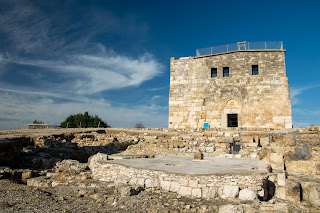
The fortress, built during the Crusader period.

The view from the top was incredible! No wonder this city was named after a bird! You can even see the aerostat, the world's largest unmanned airship, in the distance just above the mountains (around right center). 

Look! My first ARCHAEOLOGICAL DISCOVERY- a cherry jolly rancher!!!! (Thanks to my friend who left it for me to find when I turned my back, haha).


Dwellings from the first century BC (Hasmonean period): 


Now, the theater:


And the synagogue:
Which, by the way, had images from pagan mythology in it: the zodiac. Why was this allowed into the synagogue?

Unfortunately, we had to leave before we could explore the water system... and the church wasn't open to visitors. Which just means, I'll need to go back! It was a beautiful day walking through this ancient city, and I know I only just scratched the surface learning about it. 

Wow! Pretty cool, huh? What did you think about our trip around Zippori? I 100% recommend taking a few hours to explore this incredible place!

Monday, November 9, 2020

The Constantine Codex by Paul L. Maier

The Constantine Codex, the 3rd book in Paul L. Maier's 3-part series, is my favorite of all.


Published in 2011, I feel like this book solves some of the 'problems' that I had with the other two (granted, it was likely only me, as they were both bestsellers!). The prose and the dialogue match the era much better, which is more accessible to the modern reader, and I didn't find the romance as distracting (there were fewer allusions to the first book, whereas I felt like the second book revisited almost every scene of their 'fairytale romance'). 

As with the other two, this book is fiction and its story needs to be taken with a grain of salt as far as the 'incredible archeological discovery and the global ramifications' depicted, but I didn't have a problem with that. 

In fact, I loved the story itself, probably because I love books so much, especially the Bible, and love anything having to do with Israeli and early church history. This book was fascinating! I'll likely read it alone more in the future, even if I don't read the others as often. That's another thing- while each of the novels in this series could stand alone, this one definitely stands out the best (even with it's references to the earlier ones).

Something fun that stood out to me as well was that I read this book a few days after finishing Nabeel Qureshi's Seeking Allah, Finding Jesus. Part of the storyline of Maier's novel involve a debate between a Muslim leader and the main character, Jonathan Weber. Many of the same 'arguments' that Weber's character used line up exactly with Qureshi's story. I found this a happy connection (being that Maier's book is fiction, but Qureshi's is nonfiction), and showed the incredible depth of Maier's research and the extent of his masterful weaving of story while portraying truth.


I 100% recommend The Constantine Codex. You can find it here on Amazon if this book interests you! And please let me know what you think!