Showing posts with label Masada. Show all posts

Monday, September 25, 2023

Tel Gezer: Watch out for bats!

What do you know about Tel Gezer?
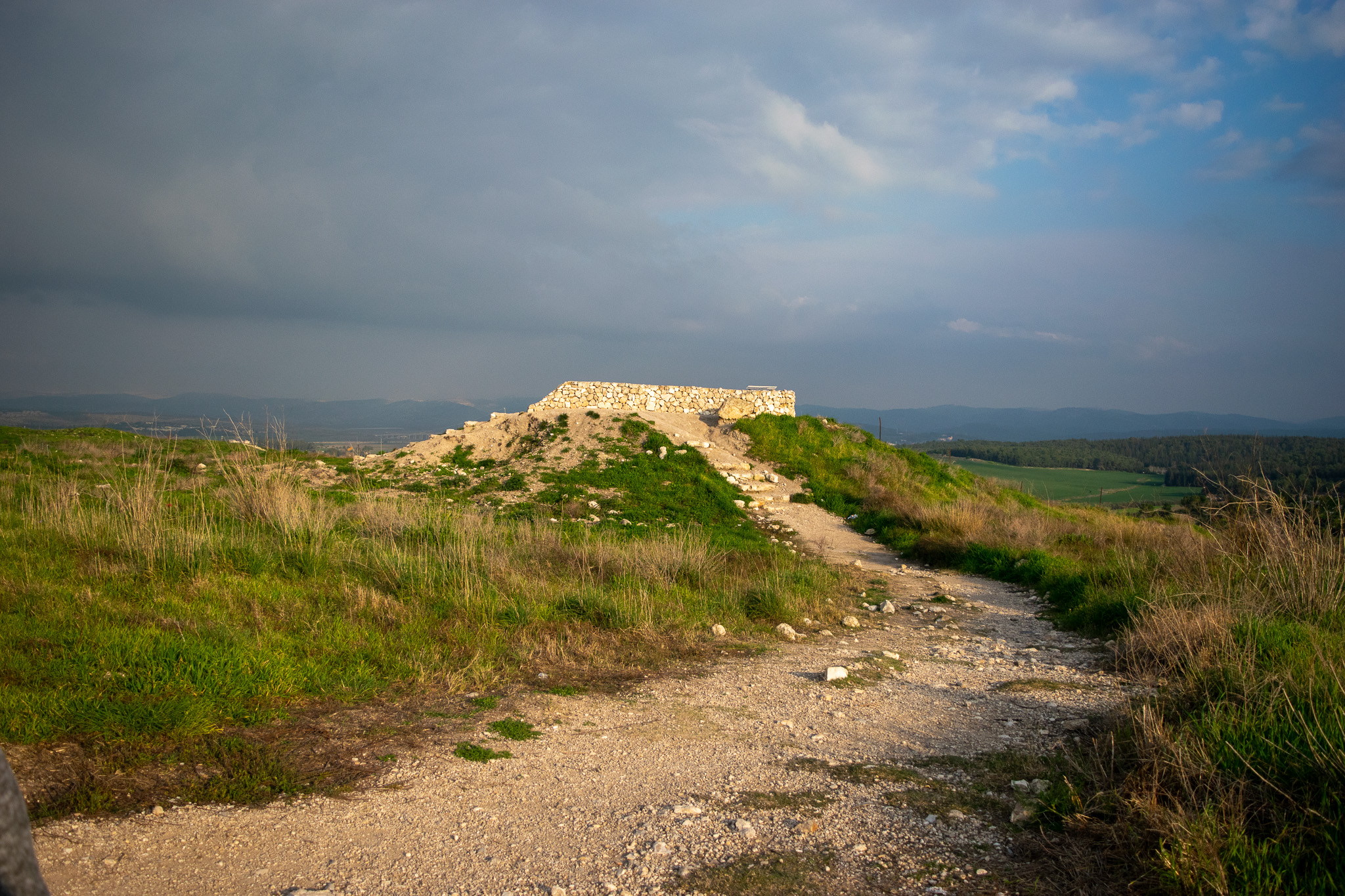
Tel Gezer lies in central Israel, south of Tel Aviv and west of Jerusalem. A major biblical city that was conquered by Joshua (Joshua 10), given to the Levites, and fortified by Solomon in 1 Kings 9 after it was given to him as a wedding present from Pharaoh, its ruins date back to the Bronze Age and including civilizations like the Canaanites, Israelites, Assyrians, Babylonians, Persians, Greeks, and Romans.


There's so much here in this park that we're going to explore in 2 posts. First, the ruins!


We first come to the Canaanite tower, which is close to the city gates. What's interesting here is how far down the archeologists had to dig just to get to it! Can you see the contrast from the tower remains to the height of the wall directly behind it?


Above is the remains of the tower. 

Next to it is the water system. I was going to go down there and then I heard that one was in fact full of bats- more than 1 million!- and my tour guide said: "Remember, 1 million bats = a lot of poop." I said, "That's okay, I'll take a picture of the entrance, haha."


From there, you go around to the Canaanite Gate:


Made of mud, I can't help but think of the 4,000-year-old gate at Tel Dan. Remember how well preserved it is? This one is not as well preserved.


But, can you see the mud bricks that still remain? How cool is that?

From here, you go up the hill and can see the ancient Solomonic-era city, complete with its city gates—the same ones that match Megiddo and Hazor!


The views to the valley beyond are beautiful. On the opposite hill you can see the caves mentioned where the kings of the conquered cities were buried in Joshua.


The 6-chambered Solomonic Gate!


In these photos, you can see the walls of the city are actually double-walls, with a chamber between them. It reminded me of Masada, where the families of the warriors were right there in the room with them. 


What was cool about this part were the families picnicking near the ruins. Children were exploring, walking around the walls and jumping between rocks. It's so mind-boggling to see ancient and modern side-by-side, and such a picture of how time moves on.

That's it for part 1 of Tel Gezer. Next week's post is about the most powerful part of the visit for me. See you then!

Monday, May 29, 2023

The chilling story of Lachish

I don't know how to tell Lachish's story.

It was a place I didn't know a lot about, and learning it as I toured it was powerful beyond words.


The 2nd most important fortified city of Judea, Lachish guarded a main trade road from Egypt to Jerusalem.

Canaanite Period:

This city dates back to before the Canaanites. At some point it was conquered by Egypt, and then possibly the Israelites or the Philistines. Its first mention in the Bible is in Joshua 10, as one of the Canaanite cities who came against Joshua at Ai. The Biblical account says Joshua chased the 5 kings of Amorites, including the King of Lachish, to Azekah (which overlooks the Valley of Elah, where David would slay Goliath centuries later). God delivered Lachish to Israel. It became part of the tribe of Judah’s land and the city was 2nd only to Jerusalem.

Israelite Period:

During the Israelite period, it held a strong position in defending the western frontier of Judea against the Philistines. King Solomon's son, King Rehoboam, fortified it in 2 Chronicles 11, and King Amaziah fled there for refuge in 767 BC (2 Kings 14, 2 Chronicles 25) after the Northern Kingdom was defeated by the Assyrians.

Assyrian Period:

Then came the Assyrian invasion in 732 BC. In all, Sennacherib, the general of the Assyrians, conquered 46 cities of Judea, and Lachish was the 2nd-to-last.


2 Chronicles 32 says that in 701 BC, during the time of King Hezekiah, the Assyrian army camped nearby,
seige to it, and built a ramp—a predecessor for the ramp at Masada- allowing then to breach the walls, taking the inhabitants into captivity. A chilling letter talks of the signal fires of Tel Azekah going out, meaning they were the last 2 cities left.


At this point in hearing the story, I had a picture of the beacons of Gondor being lit in Return of the King (Lord of the Rings), except opposite.
Can you imagine knowing the most vicious, powerful, and cruel army of your day is methodically making its way through your country, has conquered every city its encountered, and now the city closest to you, the lights you are supposed to watch, have now been extinguished?

Which means... you are next.

Today, in the British museum, is a relief that was found in Ninevah depicting this victory.


As we know, the Assyrian invasion ended not long after. God spared Jerusalem, and Lachish was rebuilt in Josiah's time.

Then came the Babylonians.

Babylonian Period:

They reached the gates of Jerusalem in 598 B.C. and placed it under seige (2 Kings 24). King Jehoiakim was murdered, and all of the nobles were exiled (including the son of King Johoiakim), all of Jerusalem excepted the poorest of the land were carried away into captivity to Babylon.

Nebuchadnezzar appointed Johoiakim as king and changed his name to Zedekiah. In 589 BC, King Zedekiah mutinied, and Babylon invaded again. This time it leveled most of the cities of Judah (Jeremiah 34). After Azekah fell, Lachish did, and then finally, Jerusalem on Tisha B'Av, 586 BC.

Persian Period
70 years later, when the exiles were allowed to return, Lachish was one of the cities that were reconstructed (Nehemiah 11). It eventually fell into ruin and was abandoned by the time of Jesus.


Today, you can walk around the top of this incredible tel, thru a gate dating back to Hezekiah, see the remains of the palace, along with a model of chairs to show the length of the reigns of Judah’s kings (we'll see that on next week's post!). On a beautiful winter’s eve, you can see the moon rise as the setting sun lights of the Judean hills in the distance- pointing the way to Jerusalem.


*some information from BibleWalks

Monday, January 16, 2023

Searching for Brimstone near Sodom

Well, if there's one thing I didn't think I'd ever do, especially on Christmas Eve Eve, it was searching for brimstone on top of giant mounds of ash below Masada, and then setting them on fire.

It was not unlike searching for Easter eggs, except with a devastatingly sobering impact as the meaning of what we found sunk in.


This is what they look like when burned in the daytime. Can you see the molten swirls of red and orange? It's hard to describe without a video, but it moves like liquid, like lava. It's fumes are putrid; we had to be careful to stand in the opposite direction the wind was blowing. 


This is what it looks like burning in the dark:


I wanted to show you the end of this journey before showing you what the brimstone looks like now, and what the search was like, because that was actually fun. But this—this isn't fun. This is what fell on the 5 Cities of the Plain (notice, it says "plain", not desert) when God destroyed it in Genesis 18-19. Before it was desert, it was a beautiful, verdant plain in the Jordan Valley, so lush that Lot CHOSE to live there when Abraham let him decide. 

After burning just one piece of sulfur, it was clear how everything would be utterly destroyed. It was stunning. (The nighttime images had more than 1 burning at a time). It's literally molten liquid, sulfuric, hotter than regular fire... did I mention putrid?

The area of the Dead Sea, the 'plain' that is now a desert, is HUGE. There were thousands of people living here, deliriously indulging in every sin and decadence they could. Abraham pleaded with God not to destroy the city if He even found 10 righteous people, and when only Lot's family were identified as righteous, God kept His word.

It's interesting to note that the Great Rift Valley goes from Lebanon to Mozambique. It's a giant crack in the center of the earth, with this valley in Israel right in the middle of it. Because of it, giant earthquakes have destroyed civilizations and killed millions over the years. 

A friend pointed out to me: could the Great Rift Valley actually be a result of God raining down brimstone and fire on the 5 Cities of the Plain in Genesis? Could that destruction actually have pierced the tectonic plates under the earth? Could they have broken under the weight of sin's impact?

Not only that, but this is what Revelation 20:10 says about Satan's future: "and the devil that deceived them was cast into the lake of fire and brimstone, where the beast and false prophet are, and they will be tormented day and night forever and ever."

This is what is burning in hell. 

After seeing brimstone burn, I understand how it is liquid-like in its movement and consistency when burning. I've smelled it (accidentally got in the path of the wind for a minute), and it left me gagging. I've seen it swirl and flow as it burned. 

It's not funny or a good time. It's eternal torment for those who do not follow Jesus as Lord. 


It's amazing to me that 4000 years after God utterly destroyed the Cities of the Plain that you can find brimstone lying on top of the ground after a winter rain in the desert. The remains of this devastation still exist today—just this. You don't find any archaeological ruins for any of these cities that you can climb on, photograph, and imagine what life was like in its heyday. 

Not, at least, like you'd expect.

Because in the area are these places where the sand is white, like here right below Masada

Actually, it's not sand. It's ash. These ARE the archeological ruins, blown around for millennia, baking in the desert heat.


And, inside of them are brimstone. In the winter after the rain, the top layer of ash flows away and the lower layers emerge. That's the best time to find brimstone, walking in the water paths.


We were there right after rain, and it made the ash hills so fun to run around on (I realize how that sounds). With every step, you'd sink about 1-2 inches into the ash, but it gave you a great grip. For once I wasn't afraid of heights, because falling wasn't going to be possible for more than a few feet—and the ash was soft. 

And then, there it was:

My friend found one to show us, and then we were able to find more. These are small, yellowish balls that are around the size of a quarter to a golf ball (harder to find). You can pick them up with your bare hands, but my palms tingled a bit after, and a friend who wiped her mouth later said it stung. It smelled like Florida water to me (sulfuric). 


There are scientists who say that these are from a volcanic eruption many years ago. I'm not even sure if there is a volcano nearby this area. But even if there is, there are volcanoes all over the world, and in NONE of those locations have brimstone been found over the past 4,000 years (for some of this time, this area was under water. The Dead Sea shrinks several feet a year, so the ground underneath has been revealed more and more over time). I see this as proof of the Biblical account, testifying to Genesis 18-20.


And I'm making an assumption that these dunes are in the exact places of the Cities of the Plains. 


One more thing... as you drive south from the Dead Sea, you'll pass Mount Sodom and this interesting rock:


Do you see the one that kind of stands apart? As you drive by, you can see that is is separated from the rest of the cliff. It's locally called "Lot's wife".

I don't believe that's Lot's wife, as I'm sure a pillar of salt would have disintegrated by now, and it probably was underwater as well. I see it more as a reminder to all who pass by to not take pleasure in the debauchery and decadence of this world, a reminder to keep my eyes only on Jesus and not look back.

Monday, August 22, 2022

Weapons, armor, coins, and more from Gamla! (Part 3 of 3)

A few months after hiking Gamla, I got to go to the museum in Katzrin with the artifacts from the seige. To say I was freaking out was an understatement!

The Katzrin Archeological Museum has an excellent display (and air conditioning, haha) of more than just Gamla. It's too much for me to tell about in this blog, so I'm just going to focus on what I consider the crown jewel: the telling of Gamla's story.

In addition to the telling of this incredible discovery (a pristine site after 1900 years... other than natural damage, haha), we were able to see artifacts from the dig. Here's just a few:


spears and arrowheads!


a piece of a scabbard

part of Roman armor

coins

coins


oil lamps, weapons, and more

WOW! I still would love to see the suit of armor that was stuck in a ceiling, but I think that's in a museum in either Tel Aviv or Jerusalem. So maybe one day!

I love being in Israel... you can enter into the story like no where else!