Showing posts with label Moses. Show all posts

Sunday, January 22, 2023

Hiking in the Wilderness of Zin

It's not everyday that after you go hiking, you hear, "Yeah, we're currently in the Wilderness of Zin. This is part of where the Israelites wandered for 40 years."

Wow!


The last part of my Christmas/Hanukah 2022 adventure included a close hike from Tamar Park. The desert here is so interesting because it is red (hence "Edom", which means "red" in Hebrew), there are these crazy formations everywhere. I'm not exactly sure what I pictured the Israelites wandering in, but I think I pictured it flatter, definitely.

As for its 'red' nature, that didn't throw me (though it was cool to be in the land of Esau!). As any good Georgia girl knows, dirt is red. What other color would it be?


So, the hike was fun. We went around this hill, into a canyon inside it, and then up.


Did I mention that I'm afraid of heights? And Israel's trails, unlike the ones in the US, do not have handrails or metal lines to break a fall. That's something I haven't gotten used to here yet. Thankfully, I was with kind friends who encouraged me (especially on the way down)!

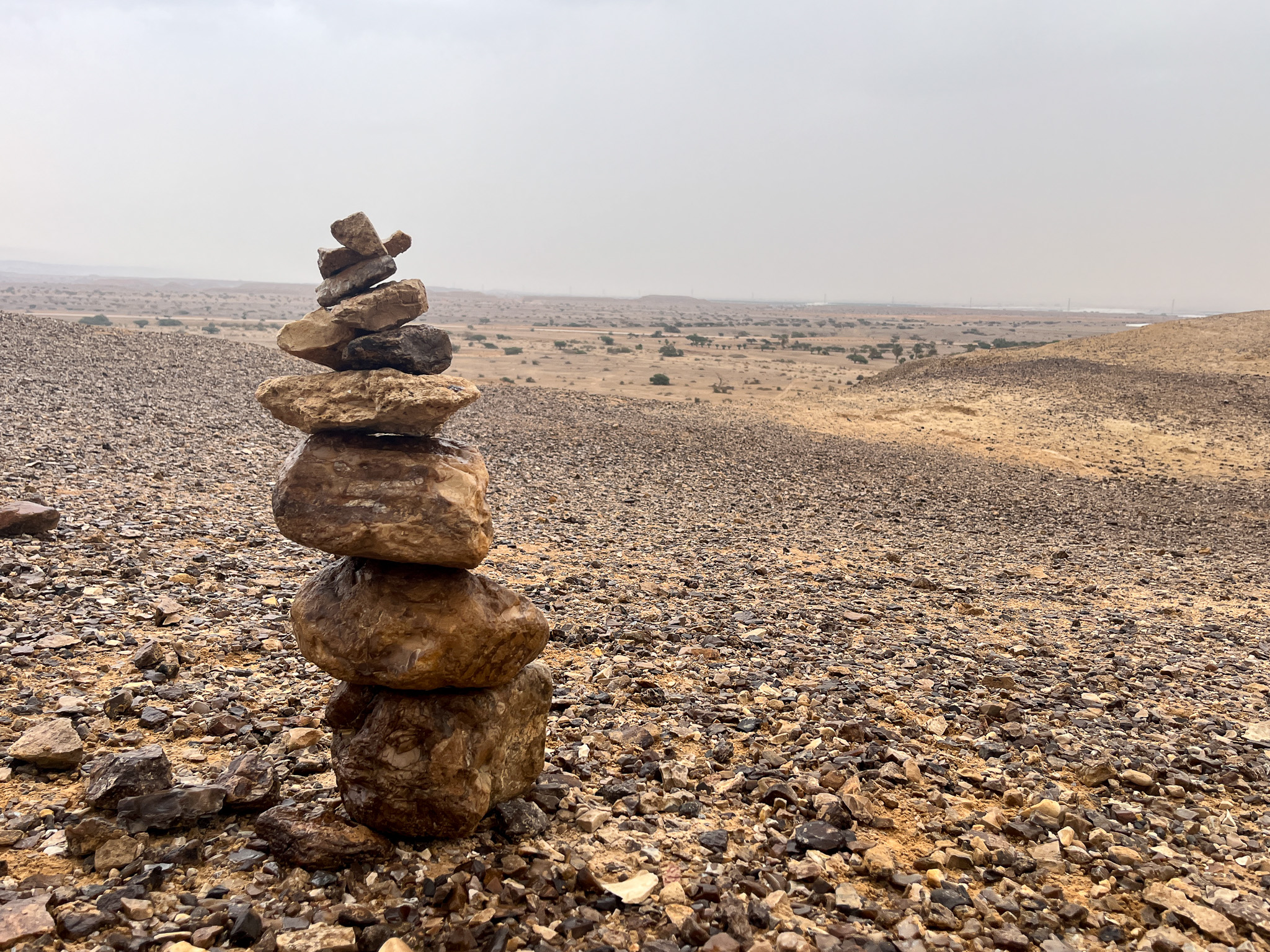
The view from the top was worth it:


The below tower has 12 stones. It's for the 12 tribes of Israel!


Amazing! What wasn't amazing was the rain that started once we all got there. Actually... any time it rains in the desert it is amazing. It just made the descent more scary, though we went down before it got too slick.

My friend also pointed out something I'd never thought of. I'm a very literal thinking, so when I read that the Israelites followed a cloud, I picture them walking behind one. But it likely covered them, giving shade in the sweltering sun. Can you imagine not only wandering in the wilderness for 40 years, seeing the same places over and over, your clothes and sandals not wearing out, and being blessed in the shade even while being disciplined for lack of faith? I imagine the pillar of fire also kept them warm on cold desert nights. I think even wandering in a desert that had interesting, varied topography and wasn't unendingly straight was also a grace, because a person could go mad plodding on and on without anything new to look at. 

Now that I've had a peek of the Wilderness of Zin, it's so much easier to picture!

And, last night in my devotions, I read Exodus 16, where God first sent the manna and quail. Guess where that was? Yup- you got it right- the wilderness of Zin!

Monday, October 28, 2019

10 Reasons Why Mount Sinai Could be in Saudi Arabia

Last week, we talked about a possible site of Mount Sinai in Jordan, and the beginning of the story behind the 'discovery' of another location in Saudi Arabia.

Are you ready to see what they found?

1st: A mountain, in the location of Midian, which is in a foreign country to where Moses previously resided (not the Sinai Peninsula, because that was Egyptian-controlled territory, and therefore not foreign)

2nd: This mountain is located to several caves, known as "Jethro's caves" to the locals. Jethro was the name of Moses' father-in-law. Locals also refer to this mountain as the mountain of Moses.

3rd: Tracing Moses' path to this mountain, he would have passed Elim in Midian, a beautiful oasis with 12 wells where the Israelites stopped.

4th: Galatians 4:25 says that Mount Sinai was in Arabia, not Egyptian land.

5th: Artifacts, potsherds, and more, dating back to the time of Moses, were found there.

6th: There is also evidence from sources like Josephus and Ptolemy.

But this is what got me:

7th: This mountain, the highest mountain in Midian, has black peak, as if it has been burned. The burned part continues more than 200 feet. But it's interesting... the entire mountain isn't burned at the top... only the outside of the rocks. If you climb up, pick up a rock, and turn it over, it's a normal color on the bottom—not burned.

This is significant, because Exodus 19:18 says that Mount Sinai was completely enveloped in fire when God descended on it.

photo from here


8th: On the mountain is the cave believed to Elijah's cave

9th: Nearby is a rock that is 6-7 stories tall that has been split down the middle. Almost like... someone struck it with a rod and then water poured out.


from Fox News.

10th: The base of where the golden calf stood is still there, right in the viewline of Mount Sinai, AND, carved onto rocks of the encampment area (which, is large enough to have held the Israelites while they lived there for an entire year) are images like... calves...and people worshipping calves... and a menorah.

This would be the oldest image of the menorah found to date, which is a symbol of Israel. Teacher Amir Tsarfati with Behold Israel says the menorah is the main symbol for Israel, even moreso than the star of David (that's a post for another day).

And this is especially significant, because the first menorah was made here, at the foot of Mount Sinai, when the Israelites first received the instructions for the Tabernacle and completed them, creating the first menorah.

Only God really knows, but that's a lot of cool evidence. What do you think?

Monday, October 21, 2019

Could Mount Sinai be in Saudi Arabia?

So, there's a mountain in Jordan believed to be Mount Sinai. At the top is a monastery called St. Catherine. It's open to the public to either ride up or hike (which I understand is a serious #legday), and is an incredible experience.

However, it's not completely proven that this is the place of Mount Sinai (also known as Mount Horeb).

traditional site of Mount Sinai in Jordan


Recently, I heard about a place in Saudi Arabia, know as Jebel Al-Lawz.

Until recently, this mountain was closed to the public. It had a fence around it and was heavily guarded by the government. But this isn't true anymore! Saudi Arabia opened it up to tourists!

So, how are we aware of this place if until this month, we were unable to visit it and all photos were banned?

In 1984, Ron Wyatt was visiting Saudi Arabia, saw this place, and took pictures. Soon after, the fence went up around the mountain. He and his sons were accused of being spies and held as prisoners for 2 months, waiting for execution! During these 2 months, Dr. Wyatt helped a lot of prisoners. His guards saw this, began to talk with him, and he convinced him of his story. He was released but had to delete his pictures. He left, but not without telling his story to others.

Fast forward more than 20 years, and a man named Dr. Kim, who served the prince and king of Saudi Arabia for 15 years, was given a reward for his service. So he asked for permission to see Jebel Al-Lawz.

What he found stunned him—and he was allowed to take pictures!*

Stay tuned for more of this amazing story next week!

*story found here

Monday, October 15, 2018

Misreading Scripture with Western Eyes: Honor and Shame

Fast-forwarding ahead to Part II of Misreading Scripture with Western Eyes, the authors take us deeper into the 'iceberg' of understanding culture and worldview.

In chapter 4, they talk about the difference between Individualist (Western) and Collectivist cultures (Eastern), and give examples of this from the Bible.


Then, in chapter 5, they explore what it means that Individualist cultures are right/wrong cultures and Collectivist cultures are honor/shame cultures—and why this is important in the Bible, which was an honor/shame world (page 114). If that sentence doesn't make sense, I definitely recommend researching this topic. It's fascinating!

To oversimplify this, Westerners see the world through right and wrong, and believe the Holy Spirit (or their own conscience) will convict them of right and wrong. Yes, actions have impact on others, but ultimately, conviction and repentance is about the individual.

In the East, "people are more likely to choose right behavior on the basis of what society expects from them. It's not a matter of guilt, or an inner voice of direction, but outer pressures and opinions that direct a person to behave a certain way. Rules and laws are less a deterrent for bad behavior than the risk of bringing shame on oneself or one's family.... If a person from a shame culture commits a 'sin', he will not likely feel guilty about it if no one else knows, for it is the community (not the individual) that determines where one has lost face" (page 116-117). The authors continue to unpack this on pages 120-127 by talking about the honor/shame language, customs, and actions in the story of David and Bathsheba in 2 Samuel 11-12. It's too long for me to summarize, but WOW- seeing this influence in this well known story really gave me another perspective!

Here are some short examples, however. In Exodus 32, when God is angry and wants to destroy the Israelites for worshipping the golden calf, Moses appeals to God's honor. "He makes a two-pronged argument to persuade God to change His mind: 1) think about what the Egyptians will say about Your name, and 2) You swore on Your name and You don't want to get a bad name! Moses doesn't appeal to God's sense of justice ('it wouldn't be right') but to His sense of honor ('You will be shamed')" p. 128.

Another example comes from Jesus. In this example, it's also important to realize something important about the concept of honor/shame. Basically, there's only so much honor. For someone to gain honor through interpersonal interaction, it means that they gained honor by shaming someone else (again, an oversimplification). Richards and O'Brien say that, "Public questions were contests. The winner was determined by the audience, who represented the community. If you silenced your opponent, you gained honor and they lost some" (page 129). This is why the disciples asked Jesus questions privately instead of publicly, as well as Nicodemus. But when the Pharisees asked questions in the open, at the Temple, it was a challenge, and every time they "lost", they lost honor. It was so enraging that they decided to kill Jesus as a criminal—this public disgrace would get their honor back (page 130).

WOW! How do these concepts impact how we can read the Scriptures? The authors conclude the chapter by recommending Bible readers to pay attention to where stories take place in Scripture (in private or in public). For us, it's a good clue as to what is a true quest for truth or a challenge.


Monday, September 4, 2017

Qumran and the Dead Sea Scrolls

The caves of Qumran (there are so many!), where the Dead Sea Scrolls were found.


A group called the Essenes lived here and copied both Scripture and other writings. When General Silva sent 10 legions (12,000) soldiers to Masada in AD 70-ish, they stopped in Qumran on the way. The Essenes had hid their scrolls in jars in caves, planning to come back to them. Instead, they were all killed.


In the 1940's, a shepherd was looking for his sheep in an area, and threw a rock into a cave... and heard something breaking. Finally, the scrolls were found.

On our last day in Israel, my friend and I went to the Israel Museum and saw the Isaiah scroll, the oldest copy in existence. SO COOL!!! #israel #apictureadayofIsrael

Also, fun fact- if you stand at Qumran and turn around, the mountain directly behind you (the last "green" one in the distance in the picture below) is Mount Nebo in Jordan, where Moses died.