Showing posts with label Tamara. Show all posts

Sunday, January 8, 2023

This desert fortress dates back to Solomon!

It's not everyday you wake up next to a fortress dating back to the time of Solomon. Needless to say, those are the days (my) dreams of made of!


But that's exactly what happened to me the weekend of Hanukah and Christmas 2022. Some friends and I were able to stay at Tamar Park, near the spring of Hazeva in the Arabah Valley of the Wilderness of Zin (part of where the Israelites wandered for 40 years).

Wow!

Being so near a spring, the location of biblical Tamara was significant, because it sat at the crossroads of ancient routes... meaning it would have been a stopping point for travelers. The archeological remains date back to the Israelite Kingdom, Nabatean, Roman, and Byzantine empires!

In 10th century B.C., the time of Solomon, this route was used to trade with Arabia, Africa, and Sheba, as is described in 1 Kings 10. Tamar is mentioned as "Tadmor" in 1 Kings 17-18. In addition to the spring, it also lay near a copper mine, which was a major trading commodity for both Kings David and Solomon. It's believed that this is why David conquered Edom in 1 Chronicles 18. Edom, which we'll talk about in a future post, is an area of the desert where the land is red. It was the ancient land of Esau. (Something that makes me wonder: it's interesting to me that the area is red, and there was copper nearby. Is there a connection here?)

Anywho, here's the entrance and the 4-chamber Solomonic gates! Remember those from Megiddo and Hazor?


But before you even enter the gates, there's actually a 4-room house dating back to 700-600 B.C. 


Nearby, archeologists found remains of shattered clay vessels used for local pagan worship. It's believed the smashing and burial of these is associated with King Josiah's reforms. 

That's it for the Israeli Kingdom history of Tamar, because this fortress was destroyed by the Assyrians in 600s B.C.

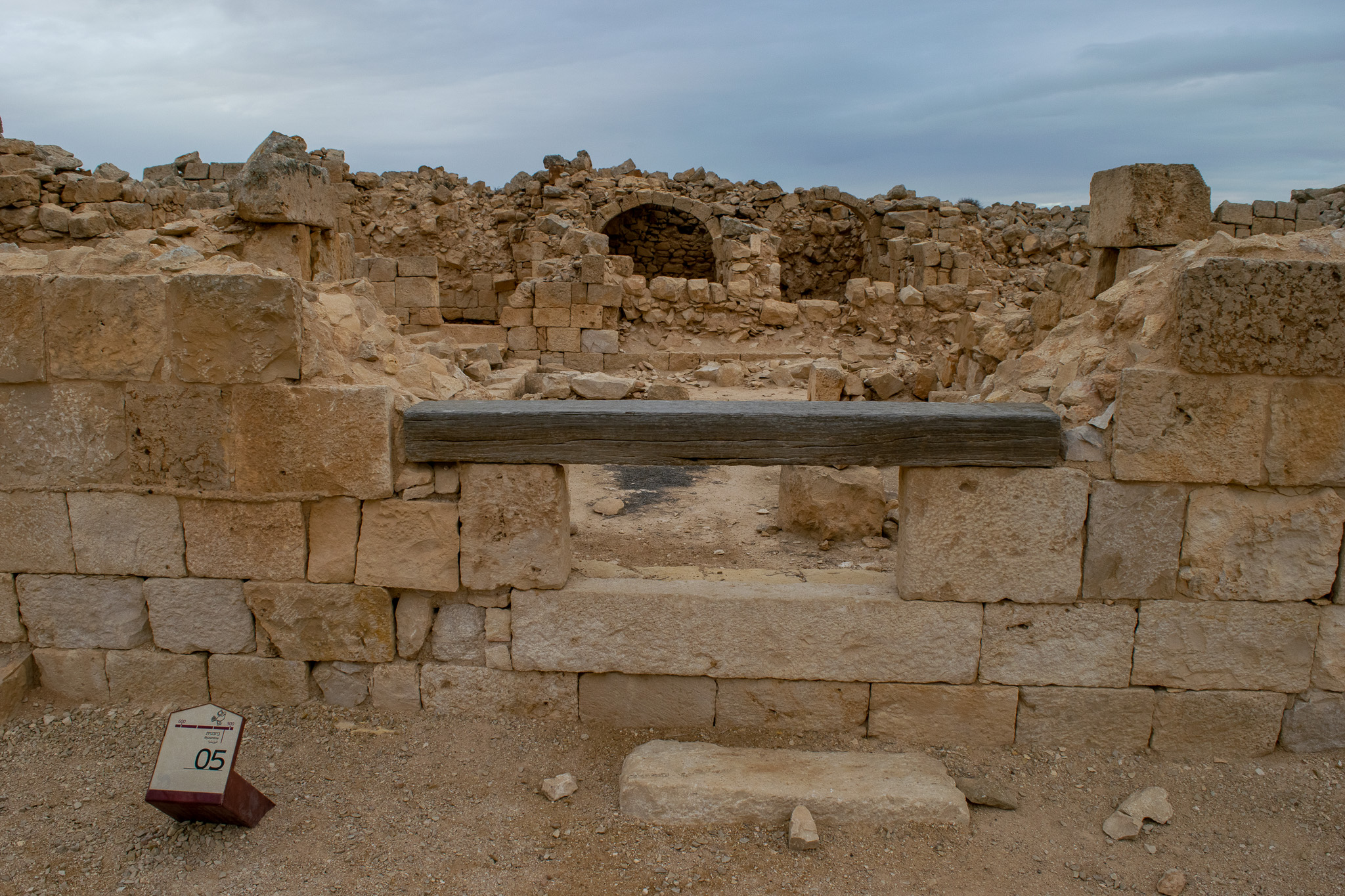
Next came the Nabateans! Underneath this fortress are the ruins of a Nabatean temple, fortress, and storage room. As with Avdat, Tamar was a stop on the ancient spice route, a 1800 kilometer, 65-day trek from Yemen/Oman to the port in Gaza.

When Nabatean King Rabbell II died in 106 A.D., Rome annexed the entire area into the Roman Empire. Tamar was known as "Thamara", and it became part of the road and defense system of the Empire.

The Romans built a square fortress with 4 towers, and later even a bathhouse and inn.


The bathhouse:


Roman construction!

In 344 A.D., an earthquake destroyed Tamar Fortress. It was rebuilt, but then the big earthquake of 363 AD destroyed it, Petra, and much of Israel. From that point, the fortress was left in ruin and never rebuilt.

During the Byzantine era, it was just a small military outpost.

From 7th-9th centuries A.D. (the early Islamic era), it was an agricultural farm. Travelers going between Mecca and Jerusalem would stop there. 

Finally, in the early 1920s, a police station was build here during the British Mandate. They actually destroyed part of the archeological remains but using those stones to construct it! I mean, I understand working smarter, not harder, and using close materials, but what a loss! 

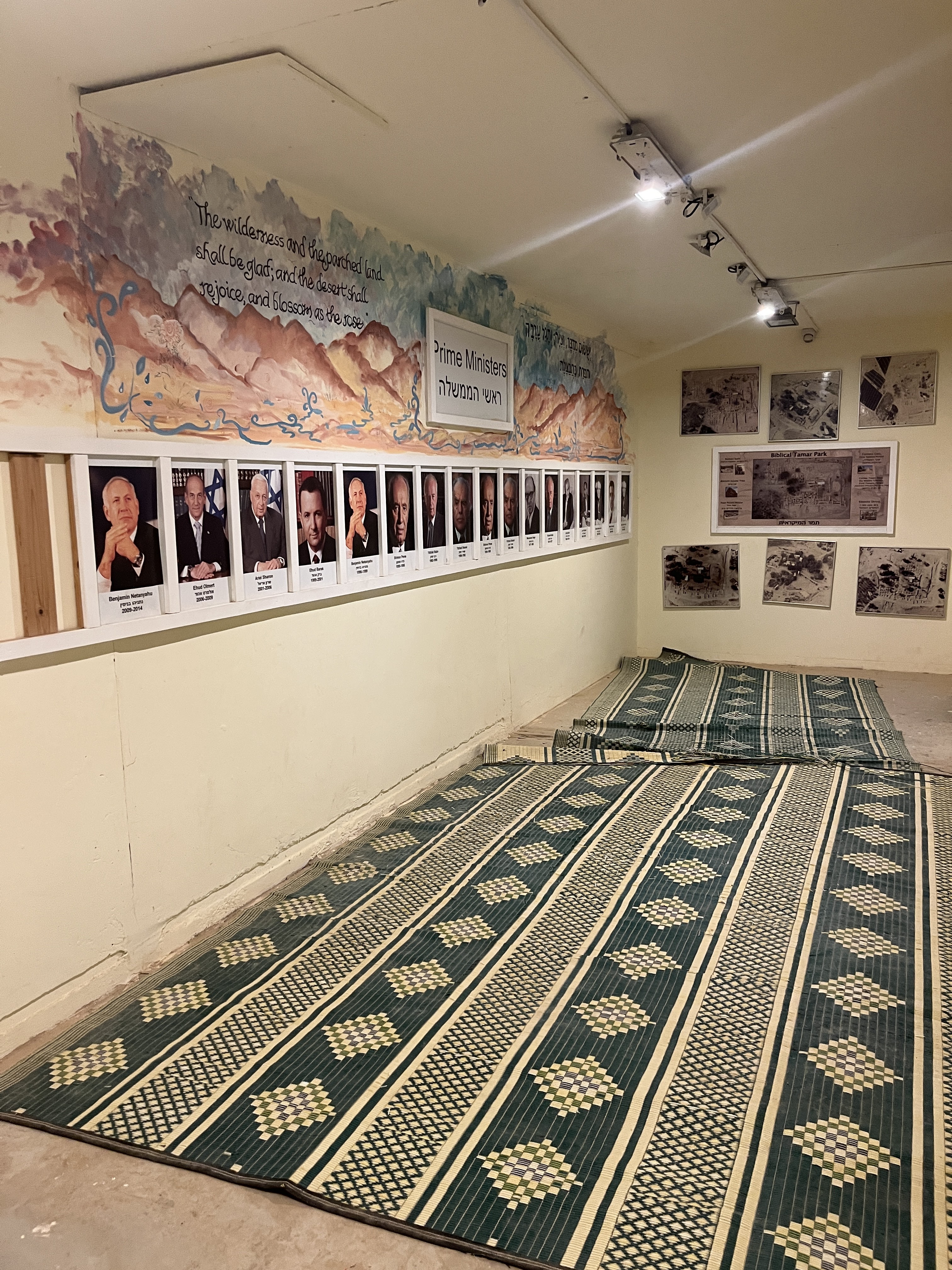
Anyway, you can go into the police station and the underground bunker. There are photos on the walls of all of the Prime Ministers and Presidents in the bunkers, and the police station has photos and information of important Israelis and others who aided in the rebirth of Israel in the Land.

I love how light glows through the open back door of the bunker in the photo above!


Wow, what an amazing history in this place!

One more thing to feature in this blog, because it's pretty cool. According to BibleWalks*, this is the oldest tree in all of Israel. Wow! It is somewhere between 1500-2000 years old, and has survived this long because of the spring of En Hazeva! Wow! I saw the tree, but in photos it looked like a mess (and I didn't see a sign near it), so I am posting their picture below:

This tree would have been there during the Roman era! Wow!

I definitely recommend visiting Tamar park if you get a chance. It's beautiful, and it's free to walk explore the archeological park.


*I didn't have a tour and the only brochure I saw was in Hebrew, so all the information I learned about Tamar Park is from Bible Walks.

Tuesday, December 27, 2022

Did the Magi stop here on the way to Bethlehem?

From where—and through where—did the wise men travel?


I've never really thought too much about this, although I heard once that they travelled through Petra (modern day Jordan) on their way to Bethlehem. So when I planned a trip over Christmas weekend to the Negev desert, which is south of Be'er Sheva, and therefore south of the boundaries of ancient Israel, I didn't expect to see any Biblical places, let alone find a Christmas connection.


While watching googlemaps on the bus south of Be'er Sheva to Mitspe Ramon, I saw Avdat National Park on the map. Then I saw it was originally settled by the Nabateans, the same people who lived in Petra. So then I knew I had to go.


The name "Nabatean" means "Cistern digger" in Aramaic, and their kingdom included northern Arabia, Edom (Judean Desert), Moab (Jordan), Hauran, the Negev, and Sinai. Their caravans of 10-20 camels carried spices, incense, medicinal plants, textiles, dyes, silver, and gold. Each camel carried 150-200 kilos (330-440lbs), and their handler walked before them.

The route was over 1800 kilometers (1120 miles!) in the desert—a 65-day trek. Along the way were stations where the caravans could rest, replenish provisions, and trade out camels.


It turns out that Avdat was station number 62 on the ancient Incense Route (Spice Route) from 300 BC- 300 AD that went from Yemen to Gaza, passing through Petra. So if the wise men did travel through Petra and then north to Bethlehem, they would have passed by Avdat. Maybe they even stopped there briefly! 

Could the star have been visible from here?


As with all ancient roadways, they have become modern roads. So, the highway that passes Advat is likely the Spice Route. 


After Nabatean King Rabbel II died in 106 AD, the Nabatean kingdom was annexed to the Roman Empire, who then built onto the area. After them came the Byzantines. So, on top of this tel is a WEALTH of archeological structures, not to mention the view!

We had less than 90 minutes to explore the whole structure, which was almost impossible. But we made it by just skipping a few areas that were less interesting to us. You can basically picture me running up the mountain, camera in hand determined to explore the entire tel. It was so much fun! 

So, here's part of my self-tour of Avdat, starting with a home from Roman times:

LOVE all these arches!


(a lot of wine was made here... they found 14 winepresses!)


The main complex at the top is HUGE! There were 2 Nabatean temples and 2 Byzantine churches (one was a monastery)... and it was all attached to a Roman fortress!


the entire complex from below (photos above and below)


Nabatean temple
just part of the view!

One of the Byzantine-era churches (the other was a monastery) and has graves with Greek-inscribed grave stones in it. Christianity came to the region during the Byzantine period, and it became the official religion. The remaining Nabateans accepted the new faith and replaced their script with Greek. 
Another Nabatean temple


Peek-a-boo!
I mean, this view!


Then, onto the Roman Fortress, which had a tower where you could view the entire complex:


In the photo above, the closer ruins are Nabatean, the farther ones (top right) are from the Roman army camp.

When you leave the fortress, immediately in front of you is a massive wine press and the remains of the Byzantine settlement, which was destroyed in a massive earthquake. Throughout the route through the 'neighborhood' there are some excavations and neat finds (apparently, somewhere in there is a Nabatean pottery shop):


Love the double arches below! #mcdonalds?


Then, you exit by the southern Roman tower (which, at the time I thought was locked, but 2 pictures above have people on top of it, so that was a missed opportunity):


Finally, you walk past the caravan (pictured above), and see one more Roman villa:


Talk about incredible! I love a room with a view!


And what a view it is!


The view towards the main part of the tel:


We made it down just as the park was closing, and while we waited for the bus, got to see the sun set (It sets at 4:30pm in the winter):


What an amazing adventure, which was extra-special because of exploring this place on Christmas day!

What did you think of it? What do you know about the wise men?

By the way, I hope you had a Merry Christmas and have a wonderful New Year! See you then!