Showing posts with label tour. Show all posts

Monday, September 19, 2022

King Saul's last battle: the view from Ahab and Jezebel's back porch

I’m actually not sure if there is anything cooler that looking out over the Jezreel Valley while your guide reads from the Bible and says, “So, Saul’s men were camped there at the trees” (bottom right of the below photo)

“and the Philistines were near there” (the town on the left edge) “and then Saul went to the witch of Ein Dor over there” (not pictured) “who foretold his defeat and death.

When Saul and his sons retreated in battle to Mount Gilboa” (the barren mountain below),

they died (Saul fell on his sword)… and then their headless bodies were taken back to Beit She’an, which you visited before lunch!”

😂

Oh, and all of this was told to me while we were sitting from the back porch of Ahab and Jezebel's winter palace in the Jezreel Valley. 😱

I don't really have pictures of the ruins, because they are all covered up and dangerous to wade through. They were behind me, but because of the rise of the mountain, I couldn't really see anything. Apparently, there's nothing there to really see, as it was never built back up into a park.

Just this amazing view, and the ability to see exactly the last battle of Israel's first king.

Oh, and do you remember why Mount Gilboa is barren? 

Monday, September 5, 2022

Beit She'an: Trapped in Time

Beit She’an is one of those places that I knew was cool when I visited in 2017, but was unable to fully grasp just how incredible it was. I think I was on overload at the time.

So when I went back, I got to be amazed all over again!


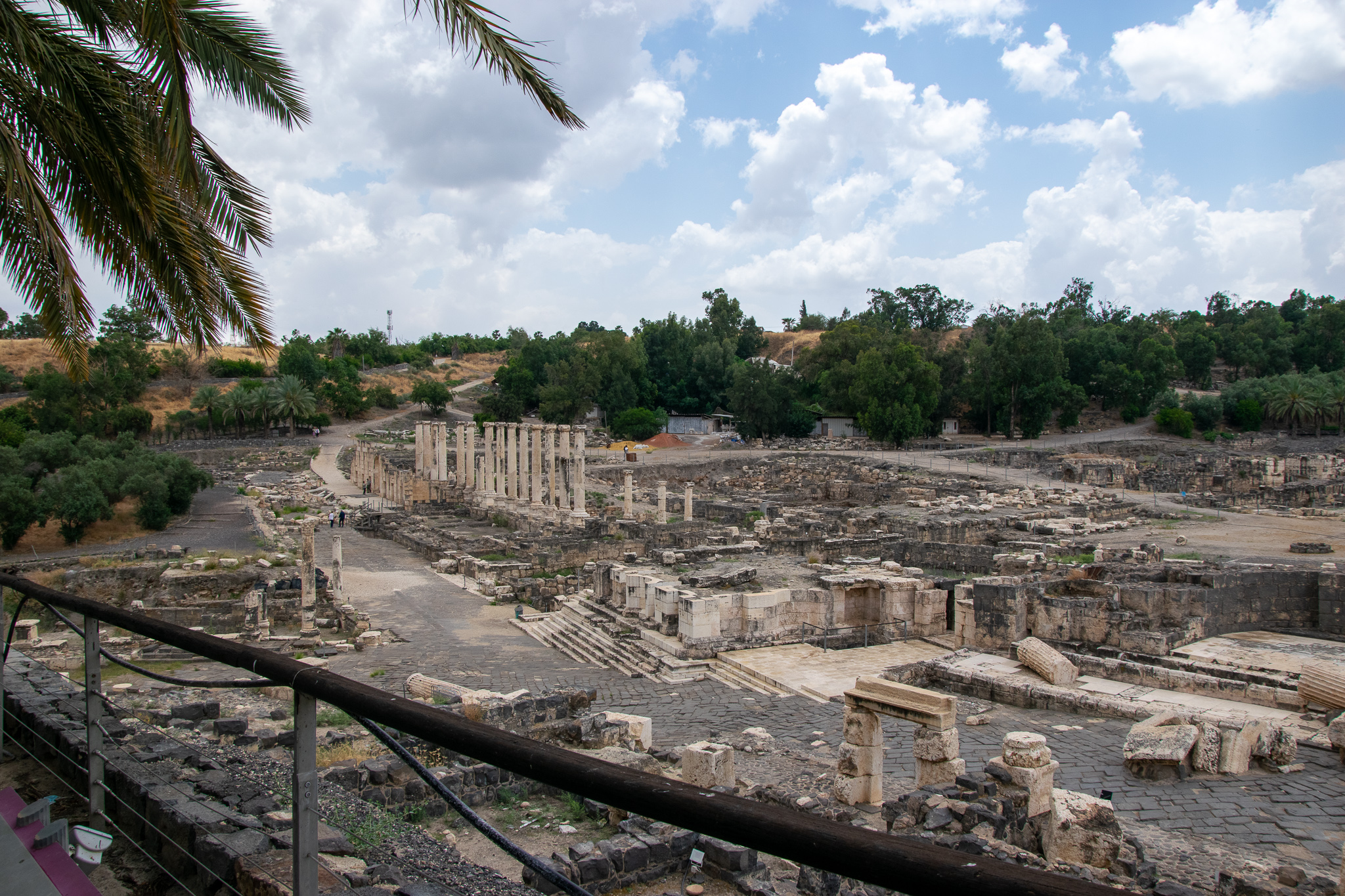
One of the 2 cities of the Decapolis as mentioned in the NT that is in Israel (the other being Susita in the Galilee), Beit She’an was a thriving Roman city during Jesus’ day. It was built at the foot of a tel dating back millennia- the same place where the Philistines hung the headless bodies of King Saul and his sons over the walls (1 Samuel 31:8-13). From a theater to a bathhouse and public toilets, this place had it all.

The bathhouse:


View from the main street (cardo):

The cardo, or the main street going through the center of town:


The statues here show at least 1 thing this city was known for...


Until 749 AD, when a massive earthquake shook the entire region- the largest in recorded history. All this splendor fell down and cracked open, stately columns rolling this way and that until they finally stopped laid in testament to the tectonic game of pick-up sticks the earth played on that fateful day. When the city was found and excavated, coins dating to 749 AD were found, marking the exact date of destruction almost as well as a stopped clock.


These columns are massive... grown men can't wrap their arms around them.


Once again, I went up to the top of the tel. The view was stunning!


On a clear day, you can see all the way into Jordan from the other side:


At the top of the tel lie more ruins, this time of the Philistine village. But, they dug deeper and even found the governor’s house from when the Egyptians controlled the area! That’s MILENNIA ago!


WOW! If you ever get a chance to visit Beit She'an, I highly recommend it! The magnitude of it is overwhelming.

Monday, September 6, 2021

The Rock, The Road, and the Rabbi: Mic drop!

I loved reading Kathie Lee Gifford's The Rock, the Road, and the Rabbi, probably because it reminded me of my trip to Israel in 2017. 

She went to a lot of places I went to, so I could see them in my mind's eye—but her tour guide was Ray Vander Laan, whose videos with Focus on the Family are incredible. I've heard there's a 3-year wait to get on one of his tours (probably longer now thanks to covid-19), but it's always good to dream. 

This book is an easy read, as each short chapter focuses on a different location, and then Rabbi Jason Sobel (pictured on the cover) often adds to the commentary. So I'm going to make this a series, because there were so many good things I picked up on in this book.


Here's some good stuff just from the opening chapters:

"All of Scripture is meant to point to the Messiah in some way. For example, as Rabbi Jason explained to me, the first letter of Genesis is the Hebrew letter bet, and the last word of the book of Revelation is the Hebrew word amen, which ends in the letter nun. The first and last letters of the Bible spell the Hebrew word Ben, which means 'Son'. From the very first to the very last letter, everything in the Bible points to the Son!" (page 5). This really struck me, because I am currently learning Hebrew, and of course, I started with the alphabet. How amazing! I love how things are hidden in Scripture like this!

Later, on page 8, Gifford describes her first few hours in the Holy Land, following guide Ray Vander Laan up a mountain to reach Gezer, an ancient Biblical city overlooking the Via Maris (the ancient trading road that ran alongside the Mediterranean Sea). Ray explained, "The problem with the Bible [...] is that the Bible was written by Middle Easterners for Middle Easterners. But we try to understand it with a Western mindset. We try to apply our own principles and our Western understanding to a culture that is completely foreign to us". As they gazed down on this road from above and saw how it connected the ancient world as nothing else could, the lesson hit home (described on page 10). 

Then, the commentary changes and Rabbi Jason Sobel adds his thoughts, and it is like the biggest mic drop of all:

"Israel's geographic position is key, since it functions as a land bridge between Asia and Africa. But from a spiritual perspective, there is even more. I believe the land God promised Abraham has the same geographic boundaries as the garden of Eden" (page 10). 

WHAT???

I've heard that it could be in Bahrain, or even Saudi Arabia. But Israel itself being the Garden? WHOA! That's especially interesting to me because as Ezekiel 36-37 predicted, the Land has come back to life in recent decades. The very desert is blooming—which is spoken of in Scripture. And later in Ezekiel, it talks about the Millennial Kingdom and how a river will flow out from the Temple Mount, in one direction to the Mediterranean and in the other, to the Dead Sea. It says that the Dead Sea will fill with life. Could Israel really be the setting for the Garden of Eden?

What do you think? Let me know in the comments below!