Showing posts with label Roman. Show all posts

Monday, September 18, 2023

Was King Herod born here?

Last week, we talked about the history of Maresha and the EPIC battle that happened below it.

This week, we'll talk about the tel, its views, and something intriguing directly below it.


The tel hasn't been full excavated yet, so I definitely need to go back in the future! Also, to see the Sandahanna (St. Anne's) ruins. We could see it from far away, but there wasn't time to go close to it. Still, the view of it surrounded by spring's beautiful was enough for a first visit!


The 360-degree views from the top are incredible!


Below the tel, on the way to the cave with the olive press, are these interesting ruins. The villa here has been partially reconstructed, and it's too dangerous to walk on right now. It's from the Hellenistic era, and a hoard of 25 coins were found under the floor of one of the rooms. The latest coin was 113 BC, and it's assumed the house was destroyed that year (or else there would have been newer coins).

Excavation revealed cisterns directly underneath the village, which stored rain water.


The reason this is interesting, is because when Maresha was conquered by John Hyrcannus I, he left a small group there. At the time, this area had Idumean immigrants. Idumean comes from the word "Edomean", or from Edom. These were descendants of Esau, BibleWalks says this fulfills the prophecy of Obadiah 1:19: "and they of the south shall possess the mount of Esau".

Josephus says that the Hasomeans force-converted the Idumeans to Judaism, allowing them to remain there.

Who do we know, from about 50 years later, was an Idumean?

King Herod.

Was he born here at the base of tel Maresha? Could this area have been his hometown? The presence of this villa (and others not excavated by it prove a settlement here, and the findings of the coins prove the time period. History tells us the Idumeans were here. What about Herod 'the Great'?

We don't know, but it is intriguing to think about!

Sunday, August 27, 2023

Gladiators, wild animals, and a fortress, oh my!

Like I said last week, Bet Guvrin is HUGE. There's so much to it! I think you could spend all day in this park and still not see everything. from the caves running under the lush (in winter) Judean hills to what we're going to explore this week: the Roman, Byzantine, and Crusader era ruins!


WOW!

So, let's start with the Roman amphitheater. 


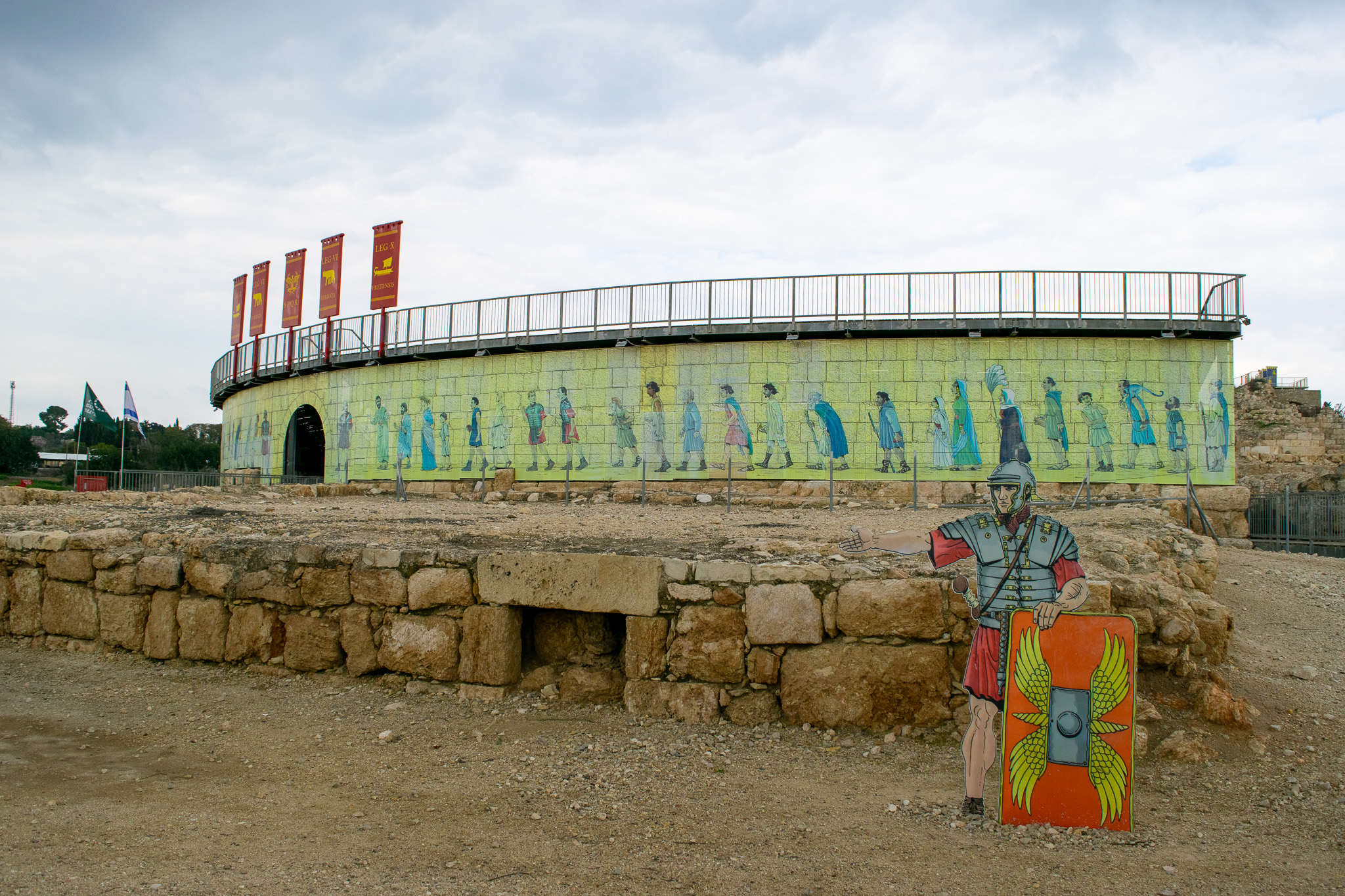
This elipitcal amphitheater is amazing to explore. You can walk through the stands (complete with cut-outs of 'audience members'), stroll through the area, and then walk through the gladiator sections. It's actually the only Roman amphitheater in Israel that is completely open to the public, and walking through it gives you a good idea what it was actually like. 


Built in the 2nd century, during the Bar Kochba revolt, its purpose was to keep the bloodthirsty Roman garrison happy and entertained, holding up to 3,500 people. There are even places next to the walls with openings for the wild animals to emerge from their cages (below).


Get this, it wasn't uncovered until the mid-1990s! I was maybe 10-11 years old. That's how long it laid under the surface! Incredible!

Close to the amphitheater is the Crusader Fortress. This area fascinating as well!

Like its BC story, Bet Guvrin's AD story is fascinating as well. The city was granted 'free status' by Emperor Septimus Severus in 200 AD, and it controlled the area between the coastal plain and the Dead Sea in that region. It became an important junction, and the city build up despite the lack of springs there, as the city benefited from Roman-era aqueducts.


The Jewish population in the area grew, and then in the Byzantine era, Bet Guvrin became an important Christian center. Then it was conquered by the Mamluks in the 6th century, then the Crusaders came and built a church (as well as the fortress), and then it was conquered by the Ottomans, who turned the church into a mosque.

Because of that, you can see the mix of materials everywhere in this fortress- and it cracked me up! You can even see it in the photo above: see how the rocks change? But I'm going to take you on a closer tour so you can see it all:


Can you see the random columns stuck in the walls? And closed entrances/arches?


There's another one! The arch below is intentional- to fortify the wall. 


But see how stones, column bases, etc. don't match each other as far as time period?


Below, right, is the church-turned-mosque:


The view from above!


Now, down into the fortress.... Only a few pictures here because we ran through it quickly.


The mix of materials cracks me up. It's like the builders were like, "Hey, this fits!" Which, honestly, is what I would do. And it matches the history of using found materials and building on former foundations.

There's such a wide mix that throughout the park are stations with flip books where you can find what you are seeing and see what era it was from, what kind of stone, etc. My friend, who was in the middle of furnishing her apartment was looking through it, and I teased her that she was looking for ideas. I mean, it was basically a giant HGTV warehouse, haha.


Can you see the base of the arch starting to curve out from the wall on the left?


That's it for this portion of Bet Guvrin. Next week is my favorite part: Maresha!

Oh yeah, one final photo. This is a simulation of a dig as you walk onto this part of Bet Guvrin, and it was awesome! One of my friend said that 'models' were the same from our Hebrew textbook, haha.


Sunday, July 9, 2023

This street is 1,400 years old!

Like I've said before, you never know what you'll find walking through the Old City of Jerusalem, especially in the Jewish Quarter!

This time it was the Cardo, the 40-ft wide, colonnaded main street dating back to the Roman Era. It's called this because it was the main street, or the heart of the city. This is where we get words in English like, "cardio" or "cardiologist", and other words referring to heart. All ancient Roman cities had a cardo, and this was Jerusalem's (once it was rebuilt under the Romans). According to BiblePlaces, this was the main thoroughfare for Byzantine (Talmudic Era) Jerusalem. ItravelJerusalem.com says it would have stretched from the Damascus Gate to the Zion Gate, and its existence is proven by the Midba map in Jordan. In addition to shops, large churches lined the street.

Today, the street is about 6 meters (20 feet) below the current street level, showing how much the level of the Land has changed in the past 1400 years. 

The north side of the Cardo is from the Roman Era, dating back to Constantine. It has not been excavated. The south side, where we walked, is from the time of Emperor Justinian is Byzantine Era.


Part of it has been rebuilt to include shops. There's so much art lining this part of the Cardo, and it was all so beautiful! I wanted to get a piece of my own!


Along the sides of the Cardo are older remains form earlier eras... 


The older looking ruins (above) are from the 1st Temple period!

The newer ones (above right) are Hasmonian (the 400 -100 BC)

There are also places to look down and see what is directly below the cardo:


1st Temple period!


This is from the 2nd Temple Era... can you see difference in craftsmanship?


Farther down were murals on the walls lining the cardo:


And, let's not forget the areas with the original stones!


Amazing!

It was so cool, I decided to join the crowd:


*information from BiblePlaces and itraveljerusalem.com.