Showing posts with label Megiddo. Show all posts

Monday, October 2, 2023

Where God made the sun stand still

I was unprepared for Tel Gezer.

The contrasts of Israel often take my breath away: the juxtaposition of the ancient and modern side-by-side, never more than a few feet (and millennia) apart... like watching children skip over the ruins of an ancient city while a modern one looks on half a mile away, or a family picnicking where a battle once took place.


What I knew about Tel Gezer before going was simple: as one of the places Solomon fortified, it is one of the remaining trio of cities with its iconic gates. I’ve been to the other 2, Megiddo and Hatzor; this was my chance to “collect all 3.”

What I didn’t know was that Tel Gezer overlooks the Valley on Ayalon, where God made the sun stand still for the battle in Joshua 10. The valley itself is huge; here are the views in each direction:


EPIC.
As sunset neared and turned the valley pink behind us, we walked back to the parking lot, passing these stone monuments.


These stones mark a place of ancient Canaanite worship. The soil below them has been tested, and the remains of burned infants had been found there, evidence of ancient child sacrifice to pagan gods.


I’d never been to a place like that, and, in the shock and the sorrow of the moment, I was struck again by another juxtaposition: how unimaginable it was to witness this place of sorrow at all, let alone maybe a mile from where the Creator of those infants made the very sun stay still in the sky.

It’s another contrast I’ll never forget.

What made it even more sobering was that the sign marking the monuments said nothing about the infant sacrifice that happened there. And nearby, a group of women sat in a circle. When one of my tour guides went to talk with them, they told her that this was a place of worship for femininity and fertility, and they were there to connect with each other and this place. They had no idea about the real truth of this place.


Monday, September 25, 2023

Tel Gezer: Watch out for bats!

What do you know about Tel Gezer?

Tel Gezer lies in central Israel, south of Tel Aviv and west of Jerusalem. A major biblical city that was conquered by Joshua (Joshua 10), given to the Levites, and fortified by Solomon in 1 Kings 9 after it was given to him as a wedding present from Pharaoh, its ruins date back to the Bronze Age and including civilizations like the Canaanites, Israelites, Assyrians, Babylonians, Persians, Greeks, and Romans.


There's so much here in this park that we're going to explore in 2 posts. First, the ruins!


We first come to the Canaanite tower, which is close to the city gates. What's interesting here is how far down the archeologists had to dig just to get to it! Can you see the contrast from the tower remains to the height of the wall directly behind it?


Above is the remains of the tower. 

Next to it is the water system. I was going to go down there and then I heard that one was in fact full of bats- more than 1 million!- and my tour guide said: "Remember, 1 million bats = a lot of poop." I said, "That's okay, I'll take a picture of the entrance, haha."


From there, you go around to the Canaanite Gate:


Made of mud, I can't help but think of the 4,000-year-old gate at Tel Dan. Remember how well preserved it is? This one is not as well preserved.


But, can you see the mud bricks that still remain? How cool is that?

From here, you go up the hill and can see the ancient Solomonic-era city, complete with its city gates—the same ones that match Megiddo and Hazor!


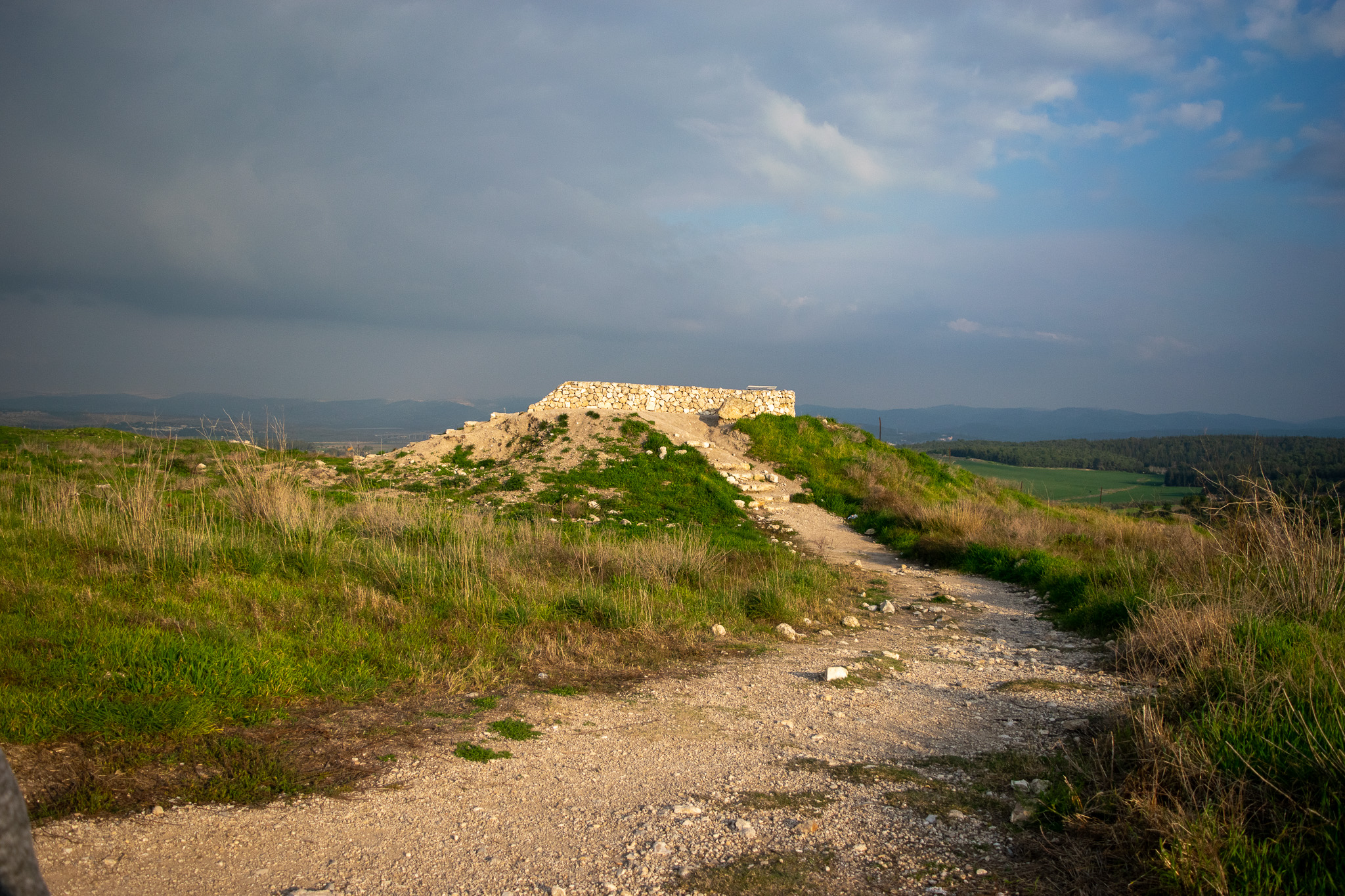
The views to the valley beyond are beautiful. On the opposite hill you can see the caves mentioned where the kings of the conquered cities were buried in Joshua.


The 6-chambered Solomonic Gate!


In these photos, you can see the walls of the city are actually double-walls, with a chamber between them. It reminded me of Masada, where the families of the warriors were right there in the room with them. 


What was cool about this part were the families picnicking near the ruins. Children were exploring, walking around the walls and jumping between rocks. It's so mind-boggling to see ancient and modern side-by-side, and such a picture of how time moves on.

That's it for part 1 of Tel Gezer. Next week's post is about the most powerful part of the visit for me. See you then!

Sunday, March 26, 2023

Exploring the prophet Elisha's hometown

Not far from Beit She'an is another tel. This one isn't built up into a national park; there's honestly not a lot going on with it. It's just there in a field, with beautiful 360 degree views of the Jordan Valley, Mount Gilboa, and Jordan. 

It's also believed to be the hometown of Elisha.


So one particularly warm day in January, I took a metronit to a train to a bus and then walked a lot to explore Elisha's hometown.

It took a lot longer to get there than I thought it would, mostly because one bus never came and then I tried to enter the field in a way that was blocked by barbed wire and had to back track to the road. But finally, I found the right path. 

Then, I climbed up and started to explore. 

First, can we talk about the views?

To the west, to Mount Gilboa


To the east... the mountains in the distance are Jordan (at the time of Elisha, that was still Israel).


Wow! At the top there are also dirt paths like you see above. There are motorcycle and dirt-bike tracks all over them, as well as footprints and pottery shards.


Most of the tel is smooth, but one excavated part remains open:


According to BibleWalks, Rehov was likely settled at the same time as Megiddo, and likely conquered by Egypt at the same time as Megiddo. It's passively mentioned as one of Beit She'an's towns in Judges 1:27. Around the time of David, it was conquered by Israel and eventually was part of the Northern Kingdom.

Excavations in 9 areas revealed that it was a large and prosperous city. Findings of artifacts from other countries prove the residents continued to practice Canaanite/Phoenician and Syrian traditions and customs.

It was eventually destroyed by the Assyrians in the 736 BC invasion. The Assyrians lived there for a while but then moved to Megiddo. It laid in ruins for 1500 years, and then a small Jewish town was built nearby in the Roman Era. In the Middle Ages, an Arab town settled on top.

What's most interesting about this tel are the findings in the opened excavated areas:


Found in the ruins was an apiary dating back to the 10th Century BC, with the remains of dozens of beehives in clay cylinders. This is unique for many reasons:

First, the apiary was very close to a bunch of houses. This means it was likely this was a source of income for the townspeople. 

Second, signs on the property say that when they tested the apiary, the found the bees themselves didn't originate from Israel. This particular group of bees came from Turkey! Apparently, they were less aggressive and more productive than Syrian bees.

So funny! 

It gives new meaning to the phrase "land flowing with milk and honey"!

My favorite part of the day, other than the adventure and the views, was going back from the tel and finding the local springs right beside it. Even though it was January, it was close to 80 degrees that day and I was hot! I waded in and cooled off before heading to the bus stop.

Definitely a great adventure!

Monday, March 13, 2023

I was unprepared for Tel Be'er Sheva

Ancient Be'er Sheva isn't too far from the modern city, but their distance spans millennia.

That's the thing about Israel... the ancient and modern are inextricably linked. You can travel a few feet and go back in time 1000 years (or more), and vice versa. It's mind-blowing!

But that's not what left me breathless this time. 

It was a hot, beautiful day in August, yet somehow I was surprised to not be overheating. Probably because it was dry heat. We walked up to tel Be'er Sheva with not long before the park was to close. 


Like I shared last week, I'd always associated Hebron with Abraham, and missed Be’er Sheva altogether in his story- until visiting one of the well museums.

I was unprepared for just how moving it was to stand in amongst the ruins of ancient Be’er Sheva and realize that it all began there. Abraham lived HERE.

But he lived here, dug wells, made a peace treaty, and offered hospitality and I couldn’t wrap my brain around that. Not only him, but Isaac and Rachel lived here, and likely Jacob as well.

This is where it all began.


the map above shows Abraham's route from Ur to Be'er Sheva

As the hot desert wind whipped my hat off my head, I read the account of him and Abimelech, and then remembered another passage I suddenly had to read. I was certain the passage I wanted was Galatians (later I remembered it was Hebrews). But Galatians 3:6-9 is where God led me and it left me speechless.


Verses 7-9: that's me! This is also the early beginnings of my story of faith, even though I am a Gentile.

There, right there, in Be'er Sheva. My roots go down there too.

WOW.

Let that sink in for you too.
.
.
.
.
.
.
Now, for the tour!
More than just Abrahamic history happened here. The land in view is also where significant events in WWI happened!


Here you can see a continued example of rebuilding on original foundations. There are 2 different time periods represented here!


Unfortunately, I did not get to go into the water system, as the lady running the park wanted to leave before closing and was angry at us. But I found out that it was dug by Jacob... you can bet I'm going back!


An early street!


Storehouses!

My favorite, though, is the ancient residential areas. I couldn't get enough of it, especially with the modern skyscrapers in the distance!


Not pictured (I could see it but my lens wasn’t powerful enough) was the IKEA right on the edge of the city.
Sarah’s favor spot for home decor?