Showing posts with label Temple Mount. Show all posts

Sunday, February 12, 2023

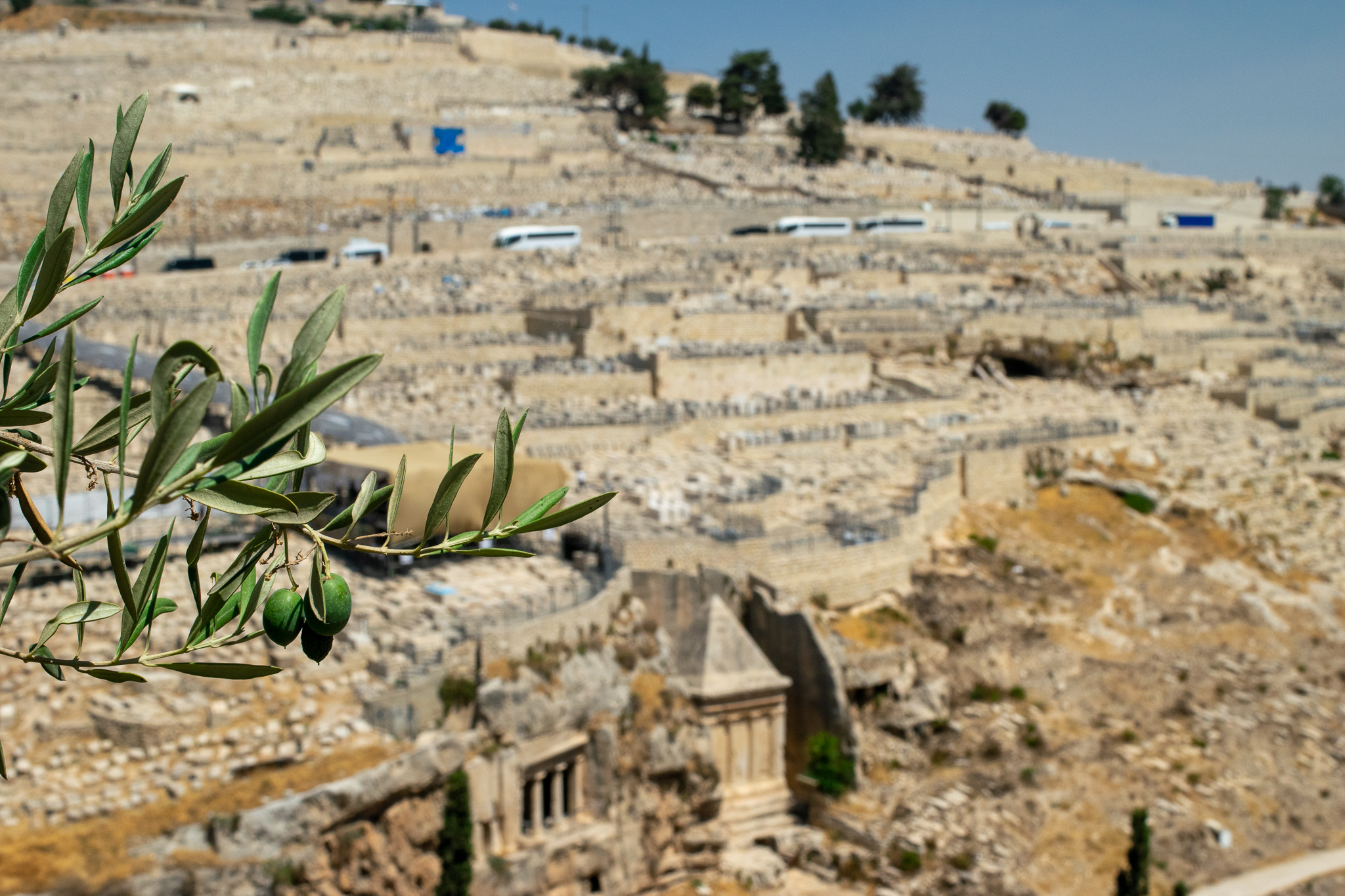
Whitewashed Tombs along the Mount of Olives

One of the many things I recommend doing while in Jerusalem is walking along the Mount of Olives. It's an incredible view of so many historic places that your mind will be continually blown. So much history in such a concentrated to area!

If you are coming from the City of David, you'll turn the corner and cross the street. The Eastern Wall of the Temple Mount will be on your left and the Mount of Olives on your right. Walking along the low stone wall, you'll be able to see the Mount in its entirety while seeking shade from the—you guessed it—olive trees.

A large portion of the Mount of Olives is a Jewish cemetery that faces the Temple Mount. From a distance, most of the graves look similar except for two. These stick out and can be seen from a distance. Do you know what they are?

The pillar above is Absolam's pillar, as spoken of in 2 Samuel 18. The one below is the prophet Zechariah's tomb.

You can actually walk right up to these pillars. They are HUGE! First, you cross over the Kidron Valley and start walking along it (we'll talk about this more in a future post). 


On the wall are signs with Bible verses specifically mentioning the Kidron Valley:

And then, there you are:


It's always cool to see something dating back millennia that is from the Bible. Nothing compares to that feeling. But a friend pointed something out to me that I want to share here:


While the architecture and the Land have changed, it's easy to accept that these pillars, as well as the cemetery, could be seen by people at the Temple when Jesus said in Matthew 23: "Woe to you, teachers of the law and Pharisees, you hypocrites! You are like whitewashed tombs, which look beautiful on the outside but on the inside are full of dead men's bones and everything unclean."

Wow!!! 

That adds so much meaning and context to this verse!

Can you see it?

Sunday, February 5, 2023

Exploring Hezekiah's Tunnel: How in the world did they do that?

In 2022, I described my visit to the City of David and standing outside of Hezekiah's Tunnel. My first visit there was an unusually cold weekend in March—gray, raining, and hovering in the 30-40 degrees Fahrenheit. Even though the water in the tunnel stays the same temperature year-round, I didn't feel like getting my jeans wet up to above my knees and just walking around in the cold.

No, this was an adventure for summer.

So, in July, I went back, and this time walked through the Hezekiah's Tunnel.

The water felt amazing, even when it briefly flowed over my knees. At first, all I could hear was the roar of the water and people yelling/laughing... and I couldn't see anything. That stayed the same the whole time, haha. There is no light without a flashlight in there (the picture above is the view when you finally emerge from the tunnel).

This 535 meter tunnel is not straight; it winds through the rock just like the dry one.

Unfortunately, there was a middle school group of the UK behind me, and the boys, who were directly behind me were constantly yelling crude things in the dark. When we finally got to the end of the tunnel, there was a small gift shop by the Pool of Siloam that had t-shirts saying, "I survived Hezekiah's tunnel". When of the boys read it out look and I looked him dead in the eyes, "You almost didn't". 

But I digress. 

Wow, being in that tunnel in complete darkness was an experience that I'll never forget. It makes the miracle of how this tunnel was created that more incredible! 

King Hezekiah commissioned this tunnel in 2 Chronicles 32:30 (2 Kings 20:20 and Isaiah 22:9) so that Jerusalem could channel its water supply from the Gihon Spring to the Pool of Siloam. This way when the Assyrians and anyone else came to lay seige, the inhabitants still had water. 

But in order to do this quickly, as the Assyrians were already advancing towards Jerusalem, the tunnel was dug from both ends and met in the middle with only a small distance between the levels. How in the world did they do that: 2 groups of men digging in rock towards each other while underground, with varying levels of terrain, and find each other within 30 centimeters (1 foot) of each other?

Amazing!

Finally, after exiting the tunnel and putting my tennis shoes back on, we passed the pool of Siloam and entered the Promenade and the Western Stepped (Pilgrim) Road.

The promenade itself has a mural depicting what life likely looked at at the time of Herod. From that, a dating back to 1st century AD leads north and up—straight up to the Southern Steps.

Below this road was a water drainage channel. Both are about 650 meters long (almost half a mile). In the channel, artifacts like coins from the 2nd Temple period, a gold bell ornament like what was on the High Priest's robe, a Roman sword, and a clay seal. According to the brochure the park gives you, this is channel was also likely a refuge for those who felt the destruction of Jerusalem in AD 70.


All those finds prove the every day use of this road, as it was when it was above the earth (and wider) in the time of Jesus. People walked back and forth. This is likely the road the blind man took when he descended from the Temple steps to the Pool of Siloam with mud on his eyes

Can you see it?

Besides the fact that it is SO COOL to walk where you know Jesus and His disciples did, there was one other perk from taking this tunnel back up to the entrance of the City of David: with it being underground, we were in the shade, in the cool of the earth, getting a break from the intense July sun. That's not to mention the earlier relief of walking through water, and dipping my hat in it before putting it back on.

I definitely recommend taking the time to visit the entirety of the City of David. I'd love to go back with a tour guide, as I'm sure there's much I didn't see. It's one of my favorite places in all of Jerusalem, just because of the treasure of history that it is.

OH, and did you hear the big news? 

The Pool of Siloam is going to be fully excavated! WOW! I can't wait to go back and see it for myself!


Sunday, July 17, 2022

Building on the Past—Literally! (Part 3 of 3)

The thing about Israel, is that there is SO MUCH HISTORY literally everywhere that it's many-layered and multi-faceted.

I just spent 2 weeks talking about sites specific to the 2nd Temple, which also are the very places that things happened in the time of the 1st Temple.

We know this because in Israel, you build on top of the past. It's very practical... the materials are already there. If the foundation is solid, why not? Now, it's also done in the name of historical preservation. 

This means, if you dug deeper, you'd find remains from the 1st Temple.

But we're actually going to move forward in history now:


I want to say again that I am a student of Israel and have soooooooo much to learn. I'm still learning all the different time periods and things. That's significant, because the rest of the structures in Jerusalem Archeological Park that I want to feature are from the Umayyad Caliphate (638 AD). A palace was actually constructed in the 8th century using the fallen rocks from the Temple Mount walls. Can you imagine? But it's practical- the materials are right there. Work smarter, not harder, and all that.

Then, a Byzantine building was constructed over where the palace had been. The building in the photo is a reconstruction based on their materials and techniques.

Which is why I'm going to end the series with this picture, because it shows this perfectly:
It was early afternoon when I took this, so I know the shadows are severe. But hopefully you can see it, either in the structure or in the sign. Basically, this building here is an example of 3 different time periods built on each other. Can you see the differences in the stone wall directly across from the sign, and how they differ from the one on the side?

I love this stuff! So cool!

What was your favorite part about this series on Jerusalem Archeological Park? Let me know in the comments below!

Monday, July 11, 2022

Is this where Jesus overturned the tables? (Part 2 of 3)

After leaving the ancient steps, I went to a place that took my breath away.

There, along the Wall, an ancient street. And rubble. Massive rock piled up on top of each other as if they’d been flipped and left with no stone on top of the other: remains from the destruction of the Second Temple in AD 70.


It was too much for me; I had to sit down.
Down that street, Yeshua and thousands of others- millions even- would have walked, passing vendors in the market stalls (that are partially still there!). This, right here, evidence of stone cold, recorded history.

Is this where Yeshua overturned the tables of the money changers?
These stones are bigger than I can describe. They reached above my head, and had to weigh literal tons. And, they are only a small portion of the original walls. When Roman soldiers destroyed everything in AD 70, they literally left no stone unturned (sounds like Matthew 24 here?). That's because fire would first of all weaken the limestone and make it like dust. It also would melt the gold filigree and any gold between the stones—and the Romans wanted to take it ALL.

According to Josephus, they spared the Western Wall so that the soldiers could rest there. Everything else was destroyed.

Streets where Yeshua walked.

Steps that millions climbed to go to worship.

Can you see it? All at the foot of the Mount of Olives, in the heart of Jerusalem.

But, we're not done with Jersualem Archeological Park yet! Come back next week for Part 3 of this series!

Tuesday, July 5, 2022

Jesus walked up these steps! (Part 1 of 3)

What if you could walk exactly where Jesus did? While in Jerusalem in March, I did just that.


Jerusalem Archeological Park sits directly above the City of David (ancient Jerusalem). I didn't have a tour guide while there, just a brochure and the signs posted around the park, but I was able to listen in as a tour guide explained in English to 2 men about this place. He especially pointed out the steps and the straight line they formed down to the City of David.


As you can see in the picture above, there's a (now blocked) triple gate, and a double gate (the arche above one is only partially visible. Travelers to the city would walk up through the city and up to the Hulda gates to worship.


You can see where the original stones still stand and where others were added on later to make the mosque. These are the original stones!


Take a look at these steps! As pilgrims ascended, reciting the prayer of ascents, the steps themselves provided almost a rhythm in how they were arranged, adding to the event.

Beside and below the steps are the remains of the ancient mikvot used for cleansing before Jews entered the Temple. There was so much there that I wanted to learn… my brochure made me wish I’d had a guide. But, I was lucky, because we'd learned about mikvot in my Hebrew class that very week! I walked around giggling, experiencing my new knowledge firsthand!


I walked all through this maze of mikvot (as the paths allowed). It was a beautiful, warm day, and tourists were just returning to Israel at this point, so I basically had it all to myself. How incredible to imagine David, Solomon, the disciples, Yeshua—EVERYONE!—walking up to the 2nd Temple to worship on this very route.


And, let's not forget the spectacular view of the Mount of Olives!


That's it for now, but not the end you'll see of this incredible place. This is only part 1 of 3 about my visit to this park. Stay tuned for part 2 next Monday!

Sunday, May 15, 2022

City of David: ancient Jerusalem's walls and Pool of Siloam

Here we are–about to visit the Pool of Siloam!

As I stated last week, the ancient Hezekiah's Tunnel leads directly into the Pool. I actually don't know where modern tourists will exit from it now, but you can see the exit at the pool. Because I took the dry Canaanite tunnel, I was able to walk and see more outside, including:

THE ANCIENT CITY WALLS!!!!!


Cue me freaking out again, because this is awesome!!!
This is a model of an ancient crane used to build these walls:
And, we saw more ancient tombs before walking through part of a village to get to the Pool:


Finally, we found the Pool!


This pool was also commissioned by Hezekiah (2 Kings 20 and Isaiah 22). The stepped structure of the baths (covered over with stone from the Hasmonean period, aka The Inter-Testamental Period) lead archeologists to say that it was an ancient ritual bath, or a mikveh


Which, leads to something very interesting my friend pointed out. In John 9, Jesus heals a blind man at the Temple by spitting in mud and putting it on his eyes. He then tells the blind man to go wash at the Pool of Siloam, which means "sent". 

Something I never realized is how far the blind man had to walk in order to wash. Now a days, that's an easier path because of modern roads, but I still looked it up on GoogleMaps:


It's 700 meters to get from the Western Wall to the Pool of Siloam on modern roads. That's almost half a mile. The man was already blind, but this time he was navigating there and dodging people, animals, obstacles, etc.—all with mud and spit running down his face! 

Wow... being here in Israel is reading the Bible with GPS... it gives so much extra context!

Here again is the exit to Hezekiah's Tunnel:


There was more to see in the City of David- an ancient market and street, for example, but at this point, it began to rain and it was in the low 40s as far as temp. My friends and I needed to get back up north for class the next day, so we decided to leave. Which just means there will be more that is "new for me" for me to see next time!

Did you enjoy this tour of the City of David? Please let me know what you liked best in the comments below!


Wednesday, January 5, 2022

Celebrating Hanukkah, Christmas, and New Year's in Israel (Part 2)

After Hanukkah, came my favorite season: Advent and Christmas! 

I had assumed that, since Christmas isn't a Jewish holiday, it wouldn't be celebrated here, and I was trying to brace myself for a very different Christmas.

Well, I was both right and wrong. It was a very different kind of Christmas, but it turns out that in towns like Nazareth, Haifa, Bethlehem, and even Jerusalem, there are areas of Christmas (or other holiday) festivals and celebrations! The weather also took a turn and became a lot cooler, as rainy season (winter) is here. So for this Georgia girl, it actually felt like Christmas!

The entire month of December, I got to enjoy these festivals, which was so fun. And then for the weekend of Christmas, I had the most different Christmas of all: spending it in Jerusalem, and actually spending Christmas Day in Bethlehem!


It was an incredible weekend, and it was also bit of a juggling game because late Christmas Even and most of Christmas Day were on Shabbat. So my friends and I had to make sure to get there before things closed, and that's why we decided to go to Bethlehem on Saturday. Besides, spending Christmas in Bethlehem... how many people actually get to do that?

And since the borders are currently closed to foreign tourists, thanks to Omicron, that meant there were only local tourists there—a very different from past years. I kept having pinch myself for how amazing it was!

On Christmas Eve, we got to Jerusalem in time to go to the Western Wall before Shabbat began, and then also went to the Church of the Holy Sepulcher in the Armenian Quarter after an amazing late lunch/early dinner. 

Christmas day, we took a bus from outside the Damascus Gate to Bethlehem. Our bus driver could have qualified for the Fast and the Furious! There was one point where I even closed my eyes, haha. But we made it, then walked to the Church of the Nativity, said to be over the cave that Jesus was born in. The line to see the cave was so long that we just walked around and then started walking to our other destination in Bethlehem: the Shepherds' Fields, also known as the fields of Boaz and Ruth. That was a long walk, so on the way back, I was so thankful to find a taxi!


The day after Christmas, time was short for us. We checked out of our Airbnb, went back to the Temple Mount, and this time we also walked up to the mosque above. That was my first time being up there. I didn't realize how big the area was up top! There's an amazing view of the Mount of Olives too. Leaving the Old City, we went to a busy shuk for spices and then headed out, stopping at the top of the Mount of Olives for a photo of the city. 

What an incredible weekend!!!

And honestly, after all of that excitement, and because the week after New Year's Eve is the week of finals in my Hebrew class, I kept the day much lower key—staying in my room, being a happy introvert, haha. So that might be a little bit of a let down to anyone who isn't an introvert, but I loved it. All I needed was my poodle, Annie, snoozing on my ankles. So, just for fun, here's a picture of her from last New Year's Eve:


We are just over a week in, so I'll say it again: Happy New Year!