Showing posts with label Bible. Show all posts

Sunday, April 24, 2022

Mount Tabor: Deborah's battle and the Church of the Transfiguration

Mount Tabor is a beautiful, iconic mountain in the Jezreel Valley, best known biblically as the location for 'Deborah's battle'. 

In Judges 4, Deborah, a judge of Israel, told Barak to take 10,000 men to fight the armies of Hazor. (Remember Hazor from 2 weeks ago)?

Like Hazor, Mount Tabor also sits on the ancient Via Maris, just farther south. It stood on the most important ancient trade route through the Land. 

So, Deborah told Barak to go fight the armies of Hazor, and he didn't want to unless she went with him. She agreed, but said that because he was too afraid to lead alone, God would give the victory over to a woman. That woman was Yael, who drove a tent spike through the temple of Sisera, the general, when he entered her tent for a drink and a nap. The Bible says the spike went all the way into the ground! WOW!

Christian tradition also places Jesus, Peter, James, and John on this mountain in Matthew 17. They went up to pray and spend the evening, and Jesus was transfigured there—and Moses and Elijah appeared with him. This obviously isn't proven, since the mountain is unnamed in Scripture. Still, we know this really happened, and why not on Mount Tabor? After all, look at the view!
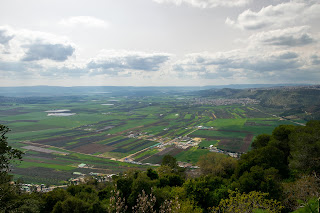


I spent Purim hiking around Mount Tabor in the Jezreel Valley, and am so excited to share about this incredible place today!

As with all locations where Catholic tradition places Jesus, there is a church at the top. Actually, there's two, a Catholic church and a Greek Orthodox one. When we were there, there was a tour group from Fiji who sang instead. I could hear it from the garden outside, and it was so beautiful!


There are 2 ways to get up to the church, drive up a switchback road with incredible views, or hike up 5k from the village below—almost straight up. We chose to drive and then walk the 2.5K trail around the summit. Because it was almost spring, there were flowers everywhere. We also saw caves along the trail—not to mention the stunning views!


Such a fun day! I definitely want to go back! Best of all, entrance is free!

Monday, November 9, 2020

The Constantine Codex by Paul L. Maier

The Constantine Codex, the 3rd book in Paul L. Maier's 3-part series, is my favorite of all.


Published in 2011, I feel like this book solves some of the 'problems' that I had with the other two (granted, it was likely only me, as they were both bestsellers!). The prose and the dialogue match the era much better, which is more accessible to the modern reader, and I didn't find the romance as distracting (there were fewer allusions to the first book, whereas I felt like the second book revisited almost every scene of their 'fairytale romance'). 

As with the other two, this book is fiction and its story needs to be taken with a grain of salt as far as the 'incredible archeological discovery and the global ramifications' depicted, but I didn't have a problem with that. 

In fact, I loved the story itself, probably because I love books so much, especially the Bible, and love anything having to do with Israeli and early church history. This book was fascinating! I'll likely read it alone more in the future, even if I don't read the others as often. That's another thing- while each of the novels in this series could stand alone, this one definitely stands out the best (even with it's references to the earlier ones).

Something fun that stood out to me as well was that I read this book a few days after finishing Nabeel Qureshi's Seeking Allah, Finding Jesus. Part of the storyline of Maier's novel involve a debate between a Muslim leader and the main character, Jonathan Weber. Many of the same 'arguments' that Weber's character used line up exactly with Qureshi's story. I found this a happy connection (being that Maier's book is fiction, but Qureshi's is nonfiction), and showed the incredible depth of Maier's research and the extent of his masterful weaving of story while portraying truth.


I 100% recommend The Constantine Codex. You can find it here on Amazon if this book interests you! And please let me know what you think!

Monday, August 3, 2020

Acts of Faith Series

Continuing with the theme of the Early Church, I want to share about this really cool series I read a few years ago. The Acts of Faith series is fiction, set in the time of the crucifixion and right after. It follows characters like a Roman-centurion-turned-Christian, the disciples, Stephen and so many more.

Essentially, it's a fictional retelling of the beginning of the book of Acts.


What I love about this series is how the authors brought that world to life. Suddenly, the reader is immersed in the culture and issues of the day. What does it mean for the Roman centurion who now is a follower of the Way? What is it like to be a Jew and suddenly also be a Christian—in a very Jewish culture? How does it feel to be "figuring Christianity out" in this world?

The scene that hit me the most in this series is with Ananias and Sapphira. The reader is right there, seeing Ananias bring his offering, lie, and drop dead, and then the same happening with Sapphira. To us, it's a retelling of a story we know—no big deal. But to the early church... wow. Can you imagine being there that day and seeing what happened? Or hearing about it after? What would your first thought have been after? Would you have been afraid? 

Obviously, the seriousness of what it meant to become a follower of Christ isn't lost on them, as so many were witnesses to Jesus' crucifixion, burial, and resurrection. But, the "stakes" don't stop there, as now they are trying to figure out what it means to be the Church... and it's not in a bubble, but right in the heart of the Roman Empire, where followers of Jesus are actively being persecuted and killed. 

Unfortunately, this series ends WAY too soon. I was SO EXCITED to get to Paul's story and his journeys, but it stops abruptly. It's still a wonderful read; I just hope that one day I can read the re-telling of the rest of the Acts story through this series!

Tuesday, April 7, 2020

Happy Passover Week!

This is such an important week for Jews and Christians around the world. Starting with Palm Sunday yesterday to Resurrection Day on Sunday, it's a time of remembrance and celebration in the Christian faith.

For Jews, it is Passover, also a time of celebration and giving thanks for deliverance—the deliverance of their ancestors out of Egypt.

Passover 2020 officially starts on Wednesday, at 7:03pm Jerusalem time, and this year will be especially poignant:

For the first time in over 3500 years, Israelis will not even be able to leave their houses over Passover. While this is due to COVID-19, it's interesting because in Exodus 12:22, when Moses gave the people instructions about what to do, he said, "None of you shall go out of the door of his house until morning."

Wow! What a fascinating time we are living in!


Monday, February 17, 2020

Reading through the Bible Chronologically

A few years ago, I decided to read through the Bible chronologically, which is something I've never done. I've always just read it in the order it exists in the modern-day Bible, or read specific sections or books at a time.

But this time, I wanted to understand the Story of the Bible even more.

So I found this plan online and purchased the mac daddy of study Bibles. I love this Bible because it has an overview of every book, as well as in-depth content on translations, cultural information, historical information, cross-references, and so much more. It has maps, charts, graphs, and even photos of the confirmed ancient places. I got new highlighter pens and soon, my Bible was psychedelic in the best possible way.

I once lived with a cat, and he loved the book of Leviticus most of all

I learned soooooooo much from this study. It took me a year and a half, but it was soooo worth it. Since I started right after I returned from Israel, I was able to see so much more in my mind than I had before. I was able to connect people and stories to places in ways I hadn't before. It gave me a big thrill to mark with a bright blue * all the places I'd been! I wasn't in a hurry, so it took me about a year and a half to complete, but it was 100% worth it. The benefit of reading chronologically is that you are reading in 'real time'... like, you read about David hiding in the caves of En Gedi in 1 Samuel and then the Psalms he wrote while there. You're able to match what prophets were alive during which king's reign.

There were so many moments that took me by surprise, even though I knew what was going to happen. For instance, as the Old Testament counted down to 586 BC and the destruction of Israel under King Nebuchadnezzar, I was unprepared for how heartbreaking it was to finally get to that part and see it happen. There were so many moments of small verses or phrases that took my breath away, like in Joshua 21: 43-45, where it says that God fulfilled His promises and gave the Israelites rest in their own land, as well as instructions on how to live... only read just pages later about their rebellion.

Perhaps the most exhausting part was reading of the different kings who followed the Lord and the ones who didn't. It seemed like almost every other one put up altars to false gods in the high places, and then the next tore them down. It made me tired to read even though I knew it happened over generations, and wonder about the people putting them up and taking them down. Didn't anyone say, "Wait, I built this like 60 years ago, then I was commanded to take it down, and now I'm building it again?"

Anywho...if you've never read the Bible chronologically, I highly recommend it. The plan is free (see above), and you don't need to buy a new Bible. I just wanted more contextual info than my regular Bible could give me. Reading through this plan was the best thing I've ever done, and I can't wait to do it again one day.

Have you ever read through the Bible chronologically? What did you think? Please let me know in the comments below!

Monday, February 3, 2020

Discovery at Magdala

So, while I was in Israel in 2017, I learned something very interesting about the land itself.

Because there are so many unexplored archaeological sites (and many that no one knows about because they are buried so deep), people will just randomly stumble on ancient artifacts. When that happens, everything shuts down and they need to call in officials. When people buy property, they can build on the land, but anything found in the land (or under the earth) belongs to Israel. It's like how in Texas you can buy property and own land, but not own the mineral rights (so if you find oil, it's not yours').

In fact, my tour guide had a friend in that very predicament. He bought property to build a house, and when they started, the remains of a Philistine settlement were found. So the friend had to stop construction while archaeologists moved in. Fast forward many years later and everything has been excavated and the friend finally has his house—on top of a museum of Philistine artifacts. 😂


Something similar happened at Magdala a few years ago. In 2009, Fr Juan Solana purchased land in Magdala, Israel, in order to build a guesthouse for pilgrims. During the mandatory archaeological testing, they discovered something amazing—the remains of "the only first century synagogue on the Sea of Galilee – one of only seven synagogues from this period in the world – along with the archaeological remains of the 2,000 year-old city of Magdala" (quote and photo from here).

In Israel, there are 4 kinds of places: places with no official record of Jesus officially being there, places where Jesus was in the area so it likely could be where you were standing, places where we know it happened either "here" or "there", and places where we know without a fact that Jesus was there.

The discovery of the synagogue is the latter—with a certainty we can say that Jesus was here, and likely taught in this very synagogue. WOW!


When I was there in 2017, this location wasn't available for me to visit. It is, however, open to the public. Needless to say, it's now on my list! Maybe on my trip in March? That would be awesome!

Monday, January 27, 2020

They Turned the World Upside Down

AHHHHH!!!!

So, last Saturday was my birthday and I just found out that Charles Martin has a sequel to What If It's True? coming out! HAPPY BIRTHDAY TO ME! It's called:

 They Turned the World Upside Down: A storyteller's journey with those who dared to follow Jesus


3 guesses as to who this is about (*ahem* Early Church *ahem*)!

I'm SO EXCITED! And wondering how I'll be able to wait an entire year to get my hands on this book, because its release date is January 5, 2021. (Yes, I've already purchased it; no I do not need to calm down!).

So, go check it out and even pre-order it... you can bet we'll have a series on it next year! WHY IS IT SO FAR AWAY?!? This is almost as hard as waiting for my Israel trip... which is a little over 2 months away! AHH!!! I'm so excited!!!

Monday, November 11, 2019

Underwater Land Bridge for the Red Sea Crossing

For the last few weeks, we've been talking about the site of Jebel El Lawz in Saudi Arabia, and how it is likely the location for Mount Sinai instead of the traditional Mount St. Catherine's in Jordan.

Last week, I shared an INCREDIBLE DOCUMENTARY of this site that has been hidden from public eye from the government of Saudi Arabia. In the middle of this documentary was something so fascinating that I wanted to come back to it.

One of the proofs Ryan Mauro mentions is an underwater land bridge called Nuweiba Land Path from Egypt to Saudi Arabia. The video shows the beach there of the Red Sea, and mentions the stories of interesting coral reefs... shaped like wagon wheels or parts of chariots... almost as if coral had formed around these objects, which had then disintegrated over the course of several millenia.


I actually don't know where this image above came from, because Mauro says that, this being a popular diving location, they wanted to dive and record these images themselves. But they weren't allowed to—the Saudi police showed up and didn't leave until Mauro and his crew left.

What do you think? This evidence contributes to the case of Mount Sinai being at Jebel El Lawz, as it is near this site. I'm fascinated and would love to learn more about this!


*Edited March 29, 2020: Last week, Amir Tsarfarti had a special update during this coronavirus quarantine. At minute 21:35, Tsarfarti actually speaks about this land bridge as the location for the Red Sea Crossing!


Monday, November 4, 2019

Mount Sinai in Saudi Arabia: MIND BLOWN

This series on Mount Sinai possibly being in Saudi Arabia is too fascinating (for me) to want to move on just yet.

So, I have one more goody to share with you, and it's a doozy!


Ryan Mauro—I have no idea who he is, but he has the official journalist's voice (do you take a class to learn that in school?) did a 25 minute documentary on it that I found on Fox News. It's amazing! Besides getting amazing footage, he shares more evidence than I shared yesterday, all evidence that lines up with the Biblical account, like:
  • from conversations with locals
  • to the possibly site of the Red Sea Crossing (where coral reefs grow in some pretty interesting shapes... as if they are around wheels or something, AND where there is an underground path from the other side in Egypt), 
  • to Elim, the oasis which still has 12 wells today
  • to the possible site of the altar with the golden calf
  • a massive ancient burial ground near the camp where all the graves were dug all at once (3,000 people were killed for worshipping the calf and would have needed to have been buried)
  • a structure that looks like an ancient altar (that Moses built with uncut stones and also placed 12 pillars). It leads to the place where it's believed animals would have been slaughtered for sacrifice... and remains of animals have been found below these rocks.
  • evidence of a stream that would have flowed down the mountain and near where the altar to the golden calf was (Moses threw its remains into the river), as well as a place where there were burnt sacrifices.
  • evidence of wells, where a pool of water would have formed... proving a large population once lived there.
  • The cave of Elijah, where he spoke with God, which is above where the altar was
  • The split rock, which Josephus said was still visible in his day (1st century AD) and was so big it could not have been moved.
  • The rocks underneath the split rock are smooth, as if water passed over them.
  • Hebrew inscriptions nearby with pretty strong evidence (too much for me to type here)
This Bible nerd is like 😱😱😱😱😱😱! Literally... in the middle of this, I went, "Holy cow"... and then realized what I said. 😂 My mind is completely blown, and I'm going to have to watch this like 20 more times.

Watch it for yourself—you won't regret it!


(A screenshot from the video. The 2 arrows - that I drew -  in the photo point to people. One is almost impossible to see because he's wearing khaki. The other is standing and wearing black by the side of a rock. That's how massive this rock is. It sits on a hill that is 100feet high, and the rock itself is between 40-50 feet, which a crack big enough for a grown man to fit inside).

MIND BLOWN

Monday, September 23, 2019

Esther: Royal Beauty

Okay, we are switching back to Biblical fiction, this time with two different fictional retellings of Esther's story!

First, this week we'll look at Angela Hunt's Esther, the first in her A Dangerous Beauty series.


I'm a fan of Angela Hunt, and Esther is a favorite story of mine, so when I saw that this author and written a re-telling of this story, I had to check it out.

This story is told from 2 characters' viewpoints: Esther's (her Jewish name is Hadassah) and King Xerxes' chamberlain (eunuch), Harbonah. The reader is able to follow Hadassah's journey from a child to queen, while also reading from an "insider's" perspective through Harbonah.

It's a great retelling, and really takes the reader into Hadassah's world. I also loved the depiction of Haman. She wrote him to almost to be like Wormtongue in Tolkien's The Two Towers, in an ostentatious sort of way. You can definitely see this progression in Hunt's portrayal, and because of her deep dive into the characters' flaws and inner struggles, can understand better how it happened—which makes the victory at the end all the more incredible!

If you like the story of Esther, this is a great read. Click here to purchase on Amazon!

Monday, September 16, 2019

Walking in the Dust of Rabbi Jesus: Read this Book!

That's all for our series on Walking in the Dust of Rabbi Jesus by Lois Tverberg. I hope you enjoyed it!


There's so much truth and wisdom in this book that there was no way I could summarize it. I hope the topics we discussed interested you enough to get this book and do your own study! If you do, please let me know—I'd love to talk with you about it!

To buy it, check it out here on Amazon!

Monday, September 2, 2019

Walking in the Dust of Rabbi Jesus: Chutzpah

In Chapter 9 of Walking in the Dust of Rabbi Jesus, Lois Tverberg talks about the Jewish concept of chutzpah.


Chutzpah is, in Tverberg's words, "utter nerve, sheer audacity, bordering on obnoxiousness" (page 118). She tells a story about elderly lady who boarded a bus she was on and sat down without paying. The driver asked where she was going, and the lady replied, but didn't get up to pay. Even though they were on the busiest street in rush hour in Jerusalem, the driver stopped, pulled out a newspaper, and waited for the woman to pay. Traffic came to a standstill and he refused to move. Eventually, the woman left the bus and the woman moved on.

Just summarizing the story above is making my heart race dangerously fast. Being from the South of the US, where you are always polite, don't make waves, etc., I'm stressed out just imagining this, haha. 

That woman had chutzpah—and Tverberg points out that it's part of the culture of the Bible as well. The first story she references with this is the story Jesus told of the Syrophoenician widow pleading with a judge for justice. She eventually wears him down and he decides to give her justice just so she'll go away. 

It's funny, because I used to cringe at that story for that reason. In my culture, it's rude and "wrong" to keep coming back after a "No". Imagine a child who wants ice cream before dinner, and the mom says "No", and the child keeps pleading, "Please, pleeeeeeeeeaaaasssseeeee, pleeeease!" (Even the thought of that makes me nervous!) I was taught, "No means no, don't keep asking." But there are so many stories in the Bible where people continue to plead with Him after a "No". 

Another example Tverberg gives is Abram 'bargaining' with God over not destroying Sodom and Gomorrah: "What if there are 50 righteous people? What if there are 45? But what about..." Even as a kid, I remember thinking, "Why does he keep going back at God like this? God could change His mind and say, '0, then, because you keep pushing it and pushing me.'" But as Tverberg points out, "Jesus liked a little chutzpah" (page 119), and then asks us the question that is the title of the chapter: 

What if we prayed with a little chutzpah? The point faith we're supposed to have is not supposed to be in the outcome, but in God Himself. What do our prayers reveal about what we believe about God?

Before moving on, I do want to say that Tverberg also talks about the danger of prosperity Gospel or "name it and claim it" theology. She says that most often the difference is the Jewish attitude of chutzpah in prayer is not for oneself, but on behalf of others (page 127). That's going to be really important to think about in my next post. But until then...

How can we pray with chutzpah for others? How does this concept widen our perspective on certain stories we've maybe ready a hundred times?

Monday, August 26, 2019

Walking in the Dust of Rabbi Jesus: Names

In Chapter 6 of Walking in the Dust of Rabbi Jesus, Lois Tverberg focuses on the mystery of names in Jewish culture. This is something that is very different from Western culture.


Tverberg states that from ancient times until today saying "in the name of" is the equivalent of claiming that's person's authority or behalf. It's like how today, when we pray, we often end with, "... in Jesus' name, Amen". We are claiming his status and authority as God's Son in that moment.

The idea is so much deeper in Jewish culture, however. "It's hard to overstate how important names were in Biblical times," Tverberg states on page 84. "In ancient thought, without a name, an object or being didn't even exist. Egyptian documents describe the time before creation as "when no name of anything had yet been named," and it was only when God created and named things that they officially existed.

Names in ancient Near Eastern culture were more than just descriptive words. They were reputations... legacies... identities. As we talked about in the posts "Family is Important" and "Misreading Scripture with Western Eyes: Honor and Shame", your name and the name of your family are vitally important in this culture. This is why when God redirected someone's life, he often changed their names (like Abram, Jacob, Saul, etc). And why Moses appealed to God's name in his attempt to persuade God not to destroy the Israelites for worshipping the golden calf in Exodus 32.

Throughout the Bible, the concept of God's name spreading throughout the earth is a common theme. And this is why the 3rd commandment, "You shall not take the Lord your God's name in vain" is such an important thing. Western Christians often see it as not swearing with God's name. But it's so much more than that. Tverberg states, "The text literally says, 'you shall not lift up God's name as an empty thing.' One of the was that rabbis interpreted this was as doing something evil publicly and associating God with it. It is a sin against God Himself, who suffers from having his reputation defamed" (page 88).

We see examples like this every day, and throughout history. From slavery, oppression, and prejudice, people who blow up abortion clinics or abuse family members who are under their leadership. We see it in religions of the world as well—horrible things done in the name of the god they believe in. The rest of the world is thinking, 'what kind of god is this that he would want you to do such a horrible thing?" His reputation is damaged, or taken in vain, just as God's is when people do things in His name that aren't of His commands or character.

Small examples are just as important here—businessmen who will cheat others and sit on the front pew on Sunday. Or what about cutting someone off with ours car while we have Christian bumper sticker on the back? It's giving a false witness, or a witness against Christ to the world around us.

As Christians, we carry God's name in all we do and say. And while we do know this, the full meaning of it is so much deeper because of the cultural connotations that we don't have. It's name and reputation that has been proclaimed for millennia throughout the earth—the universe—with great breadth and weight. For this reason, family names are so important in Near Eastern culture—because the name will last beyond those who bear it. In the West, it's considered admirable if someone has to rise from the adversity of overcoming negative (or toxic) dynamics and start a new, separate life. This would not be a positive thing in Near Eastern culture.

In fact, I once heard a story about a Jewish woman who heard about a practice in Germany that, due to limit land availability, grave sites are only leased for 15-30 years. After that, the grave's contents (and headstone) are removed and the land is available for a new inhabitant.

Upon hearing this, the Jewish woman said, "But what happens to their name?"

When I heard this story, I couldn't stop thinking about it. It's why it's so important to families from collective cultures to have children, and especially male children, to continue the family name. While this is important in Western culture, it's doesn't have the same gravitas. There might be shame and great pain over infertility, but the cultural implication of a complete loss of the weight of a name (identity and reputation) isn't necessarily as big of a deal. And as to people being removed from their graves 30 years after death (when it's likely that those who would visit have already passed on) is practical in light of limited land availability.

What do you think? How does the important of a name in Jewish culture from one on your own?

Monday, August 19, 2019

Walking in the Dust of Rabbi Jesus

For the next few weeks, we're going to explore another of Lois Tverberg's books: Walking in the Dust of Rabbi Jesus.


Like Tverberg's other books, this book is a deep dive into the importance of understanding the Jewish context of Jesus. This one specifically focuses on Jesus' words (teachings).

I'm currently about halfway through it and so far several things have really stood out to me. So we'll explore those topics and more in the weeks to come!

Monday, August 5, 2019

Pilate's Praetorium

Here is another teaching from Charles Martin on his trip to Israel spring of 2019. This time he's teaching from Pilate's Praetorium, taking the reader through the night of Jesus' trial and torture before going to the cross.


click here or on the photo, then select the video with "Pilate's Praetorium"


By the way, the hole in the image above is where the Romans put a pole in the ground and tied Jesus to it to be flogged. Right there. Not somewhere in a fictional story. RIGHT THERE.

Right there. 

Monday, July 29, 2019

What If It's True?: Charles Martin teaches from Capernaum

So, earlier this year, author Charles Martin of What if It's True?:A storyteller's journey with Jesus, travelled to Israel with his church for a Bible tour. While there, he taught at several locations. These teachings were filmed, and he shared the links with his fans in a newsletter.

Which basically means I get to hear my favorite author teach from my favorite place in the world—no big deal.

Anyway, one of the places he taught was in Capernaum, and it was here that he read aloud the story he'd written about the tassels/hem of garments, David in En Gedi, and the woman with the issue of blood.

So, please go buy this book! But, here's where you can hear it read aloud—in the very place it happened 2000 years ago.


Click here or on the image above, and then select the video titled "Capernaum" in the 2nd row.

Enjoy!

Monday, July 22, 2019

What if it's True?: Combatting Resignation

In Chapter 5 "Talk to the Hand—Jesus Christ is Lord of All" of What if it's True?: A Storyteller's Journey with Jesus, author Charles Martin discusses the cancer of resignation and why it is so important to put all of our trust in God.

He points out, that in Caesarea Philippi, Peter's confession of "You are the Messiah" in Matthew 16 came six days before the revelation that Jesus was in fact, the Messiah.


"At its root," Martin says, "Resignation spins a lie that says our enemy is stronger than our King. Period.... [But], truth is, our hardship does not determine HIs character or HIs love for us, and it doesn't make Him any less King or any less capable or any less good or any less in love with us. The choice is ours. We get to choose whether to fix our eyes on the giants—or the King on the throne" (pages 63-64).

On page 66, he says, "Our enemy can take you and me from warrior to wuss through our agreement with resignation". The way to fight back through the word of God. "Counter every lie with 2 promises of God. Make bookends".

Pretty great advice! And actually, you can hear him teach on this yourself. Click here or on the photo above, because while in Israel earlier this year, Martin taught on this very topic and chapter from its setting: Caesarea Philippi. And while listening to his message, you can hear the calming waters of Banias Springs, the headwaters of the Jordan River... and watch a lot of tourists walk by and take selfies, haha.

Choose the video that says "Caesarea Philippi" to get the right one.


Monday, July 15, 2019

What if It's True?: The Shelter of His Wings

As I said in the last post, I love pretty much everything Charles Martin writes. But he mostly writes fiction, so when he published a nonfiction book this year, I was curious. What if it's True? didn't disappoint!


In chapter 2, "We're all bleeders", he explores the concept of the tassels on the hems of garments, which reminded me of this post I wrote last year from Ann Spangler and Lois Tverberg's book, Sitting at the Feet of Rabbi Jesus. 

They basically explore the concept of tassels on the hem of the garments of Jewish men, especially in ancient Israel, and gave me a perspective how specific stories from the Bible that I'd never thought of before: David cutting the hem off Saul's robe and the woman with the issue of blood touching Jesus' hem. 

So, when I saw that Martin wrote a chapter that also talked about this concept and these stories, I wanted to share it here.

What I love is that Martin expands on the concepts I learned from Spangler and Tverberg's book. While they spoke about the hem showing authority, power, and holiness, he talks about its protection. Martin talks about the word "wings" used in the Old Testament to show God's protection of the Israelites, threading it from Exodus, Numbers, Deuteronomy, 1 Samuel, Psalms, Malachi... and all the way to Matthew.

The meaning of "wings" in the passages he cites have to do with cover, refuge, deliverance, and trust" (page 21). He points out that when God commands in Numbers for the Israelites to put tassels on their garments, it was because "God is practical and He doesn't want His people to forget" (page 21) and later on this page shows that the corner/border of a garment is the same word used for wings in these passages. "God was making a mental connection for His people. In a sense, He was saying, 'The corner of your garment should remind you of Me and My protection—of My deliverance and your healing" (pages 21-22).

As with the story of David cutting off the tassel of Saul's robe, Martin points out, "That tassel represented God's covering and protection. God had given Saul into David's hand. And when David held it up and showed it to Saul, and Saul glanced down at his now three-winged shirt, Saul knew it. He understood" (page 22).

As for the woman with the issue of blood:

"This woman believed the Word was more true than her circumstances" (page 27).

WOW. Read that about 50 times more, please. I know I need to.

It wasn't just her though. Martin points out in Matthew 14:35-36: "And when the men of that place recognized Him, they sent out into all that surrounding region, brought to Him all who were sick, and begged Him that they might only touch the hem of His garment. And as many as touched it were made perfectly well."

What about us? As Martin states: "The wings of His garment are here. Now. Will you reach out and grab hold?" (page 27)

So now, we've seen a connection of this physical picture of God's authority, power, holiness, and protection. How does this continuation of this theme deepen our understanding of this practice and God's Word?


Monday, July 8, 2019

What if it's True?

This year, my favorite author of all time, Charles Martin, published a book called, What if it's True?: A Storyteller's Journey with Jesus.

While Martin normally writes fiction, this book was completely true to his voice, which is nothing less than raw, powerful poetry in prose form. If you've never read his books, you need to. Don't even get me started on how amazing they are. 

Especially When Crickets Cry. 

Especially Wrapped in Rain. 

Especially A Life Intercepted. 

Especially Water from my Heart. 

Especially... but I digress.

In What if it's True? Martin takes the reader straight into the days when Jesus Himself walked on the Earth. It's not a fictional account, or a re-telling either. Each chapter focuses on a different story, with different characters interacting with Jesus. Martin steps into the story, with the reader, until they are both right in the middle of the action. 

Then he pulls away and connects the story to real life 2019 years later, tugging the reader back to the modern day.

Except that, having looked into the eyes of Jesus in each of these stories, the readers can't look away. Martin threads, hammers, and chisels his points straight into the heart, leaving the reader nowhere to go except to Scripture, prayer, and time with the Lord. And in light of that, he closes every chapter with a prayer, inviting the reader to sit once again at the feet of Jesus.

He basically is asking the question, "What if everything Jesus said and did was true, what would it mean for our lives today?"

I can't recommend this book highly enough... or this author. Please check it out!

Monday, July 1, 2019

How to read the Filament Bible: See

This is part 4 in a series on the Filament Bible and its corresponding app.

After studying your selected Scripture and reflection on the resources around it, it's time to have fun with some interactive videos from the Bible Project, along with different charts, maps, drawings, and graphs.

I love this section, as well, and have often found myself pausing the videos so I can take notes.


That's it! I definitely recommend the Filament Bible because of the app. Honestly, I prefer the NIV and for my pages to have 2 columns. This Bible only comes in NLT and is a single column on purpose—it's designed so that the lines don't run on top of each other if you look through the page. That's a cool thing, definitely. But I honestly bought the Bible just so I could have access to the app... and it was definitely worth the price to do so.