Showing posts with label Dead Sea. Show all posts

Monday, January 16, 2023

Searching for Brimstone near Sodom

Well, if there's one thing I didn't think I'd ever do, especially on Christmas Eve Eve, it was searching for brimstone on top of giant mounds of ash below Masada, and then setting them on fire.

It was not unlike searching for Easter eggs, except with a devastatingly sobering impact as the meaning of what we found sunk in.


This is what they look like when burned in the daytime. Can you see the molten swirls of red and orange? It's hard to describe without a video, but it moves like liquid, like lava. It's fumes are putrid; we had to be careful to stand in the opposite direction the wind was blowing. 


This is what it looks like burning in the dark:


I wanted to show you the end of this journey before showing you what the brimstone looks like now, and what the search was like, because that was actually fun. But this—this isn't fun. This is what fell on the 5 Cities of the Plain (notice, it says "plain", not desert) when God destroyed it in Genesis 18-19. Before it was desert, it was a beautiful, verdant plain in the Jordan Valley, so lush that Lot CHOSE to live there when Abraham let him decide. 

After burning just one piece of sulfur, it was clear how everything would be utterly destroyed. It was stunning. (The nighttime images had more than 1 burning at a time). It's literally molten liquid, sulfuric, hotter than regular fire... did I mention putrid?

The area of the Dead Sea, the 'plain' that is now a desert, is HUGE. There were thousands of people living here, deliriously indulging in every sin and decadence they could. Abraham pleaded with God not to destroy the city if He even found 10 righteous people, and when only Lot's family were identified as righteous, God kept His word.

It's interesting to note that the Great Rift Valley goes from Lebanon to Mozambique. It's a giant crack in the center of the earth, with this valley in Israel right in the middle of it. Because of it, giant earthquakes have destroyed civilizations and killed millions over the years. 

A friend pointed out to me: could the Great Rift Valley actually be a result of God raining down brimstone and fire on the 5 Cities of the Plain in Genesis? Could that destruction actually have pierced the tectonic plates under the earth? Could they have broken under the weight of sin's impact?

Not only that, but this is what Revelation 20:10 says about Satan's future: "and the devil that deceived them was cast into the lake of fire and brimstone, where the beast and false prophet are, and they will be tormented day and night forever and ever."

This is what is burning in hell. 

After seeing brimstone burn, I understand how it is liquid-like in its movement and consistency when burning. I've smelled it (accidentally got in the path of the wind for a minute), and it left me gagging. I've seen it swirl and flow as it burned. 

It's not funny or a good time. It's eternal torment for those who do not follow Jesus as Lord. 


It's amazing to me that 4000 years after God utterly destroyed the Cities of the Plain that you can find brimstone lying on top of the ground after a winter rain in the desert. The remains of this devastation still exist today—just this. You don't find any archaeological ruins for any of these cities that you can climb on, photograph, and imagine what life was like in its heyday. 

Not, at least, like you'd expect.

Because in the area are these places where the sand is white, like here right below Masada

Actually, it's not sand. It's ash. These ARE the archeological ruins, blown around for millennia, baking in the desert heat.


And, inside of them are brimstone. In the winter after the rain, the top layer of ash flows away and the lower layers emerge. That's the best time to find brimstone, walking in the water paths.


We were there right after rain, and it made the ash hills so fun to run around on (I realize how that sounds). With every step, you'd sink about 1-2 inches into the ash, but it gave you a great grip. For once I wasn't afraid of heights, because falling wasn't going to be possible for more than a few feet—and the ash was soft. 

And then, there it was:

My friend found one to show us, and then we were able to find more. These are small, yellowish balls that are around the size of a quarter to a golf ball (harder to find). You can pick them up with your bare hands, but my palms tingled a bit after, and a friend who wiped her mouth later said it stung. It smelled like Florida water to me (sulfuric). 


There are scientists who say that these are from a volcanic eruption many years ago. I'm not even sure if there is a volcano nearby this area. But even if there is, there are volcanoes all over the world, and in NONE of those locations have brimstone been found over the past 4,000 years (for some of this time, this area was under water. The Dead Sea shrinks several feet a year, so the ground underneath has been revealed more and more over time). I see this as proof of the Biblical account, testifying to Genesis 18-20.


And I'm making an assumption that these dunes are in the exact places of the Cities of the Plains. 


One more thing... as you drive south from the Dead Sea, you'll pass Mount Sodom and this interesting rock:


Do you see the one that kind of stands apart? As you drive by, you can see that is is separated from the rest of the cliff. It's locally called "Lot's wife".

I don't believe that's Lot's wife, as I'm sure a pillar of salt would have disintegrated by now, and it probably was underwater as well. I see it more as a reminder to all who pass by to not take pleasure in the debauchery and decadence of this world, a reminder to keep my eyes only on Jesus and not look back.

Sunday, January 8, 2023

This desert fortress dates back to Solomon!

It's not everyday you wake up next to a fortress dating back to the time of Solomon. Needless to say, those are the days (my) dreams of made of!


But that's exactly what happened to me the weekend of Hanukah and Christmas 2022. Some friends and I were able to stay at Tamar Park, near the spring of Hazeva in the Arabah Valley of the Wilderness of Zin (part of where the Israelites wandered for 40 years).

Wow!

Being so near a spring, the location of biblical Tamara was significant, because it sat at the crossroads of ancient routes... meaning it would have been a stopping point for travelers. The archeological remains date back to the Israelite Kingdom, Nabatean, Roman, and Byzantine empires!

In 10th century B.C., the time of Solomon, this route was used to trade with Arabia, Africa, and Sheba, as is described in 1 Kings 10. Tamar is mentioned as "Tadmor" in 1 Kings 17-18. In addition to the spring, it also lay near a copper mine, which was a major trading commodity for both Kings David and Solomon. It's believed that this is why David conquered Edom in 1 Chronicles 18. Edom, which we'll talk about in a future post, is an area of the desert where the land is red. It was the ancient land of Esau. (Something that makes me wonder: it's interesting to me that the area is red, and there was copper nearby. Is there a connection here?)

Anywho, here's the entrance and the 4-chamber Solomonic gates! Remember those from Megiddo and Hazor?


But before you even enter the gates, there's actually a 4-room house dating back to 700-600 B.C. 


Nearby, archeologists found remains of shattered clay vessels used for local pagan worship. It's believed the smashing and burial of these is associated with King Josiah's reforms. 

That's it for the Israeli Kingdom history of Tamar, because this fortress was destroyed by the Assyrians in 600s B.C.

Next came the Nabateans! Underneath this fortress are the ruins of a Nabatean temple, fortress, and storage room. As with Avdat, Tamar was a stop on the ancient spice route, a 1800 kilometer, 65-day trek from Yemen/Oman to the port in Gaza.

When Nabatean King Rabbell II died in 106 A.D., Rome annexed the entire area into the Roman Empire. Tamar was known as "Thamara", and it became part of the road and defense system of the Empire.

The Romans built a square fortress with 4 towers, and later even a bathhouse and inn.


The bathhouse:


Roman construction!

In 344 A.D., an earthquake destroyed Tamar Fortress. It was rebuilt, but then the big earthquake of 363 AD destroyed it, Petra, and much of Israel. From that point, the fortress was left in ruin and never rebuilt.

During the Byzantine era, it was just a small military outpost.

From 7th-9th centuries A.D. (the early Islamic era), it was an agricultural farm. Travelers going between Mecca and Jerusalem would stop there. 

Finally, in the early 1920s, a police station was build here during the British Mandate. They actually destroyed part of the archeological remains but using those stones to construct it! I mean, I understand working smarter, not harder, and using close materials, but what a loss! 

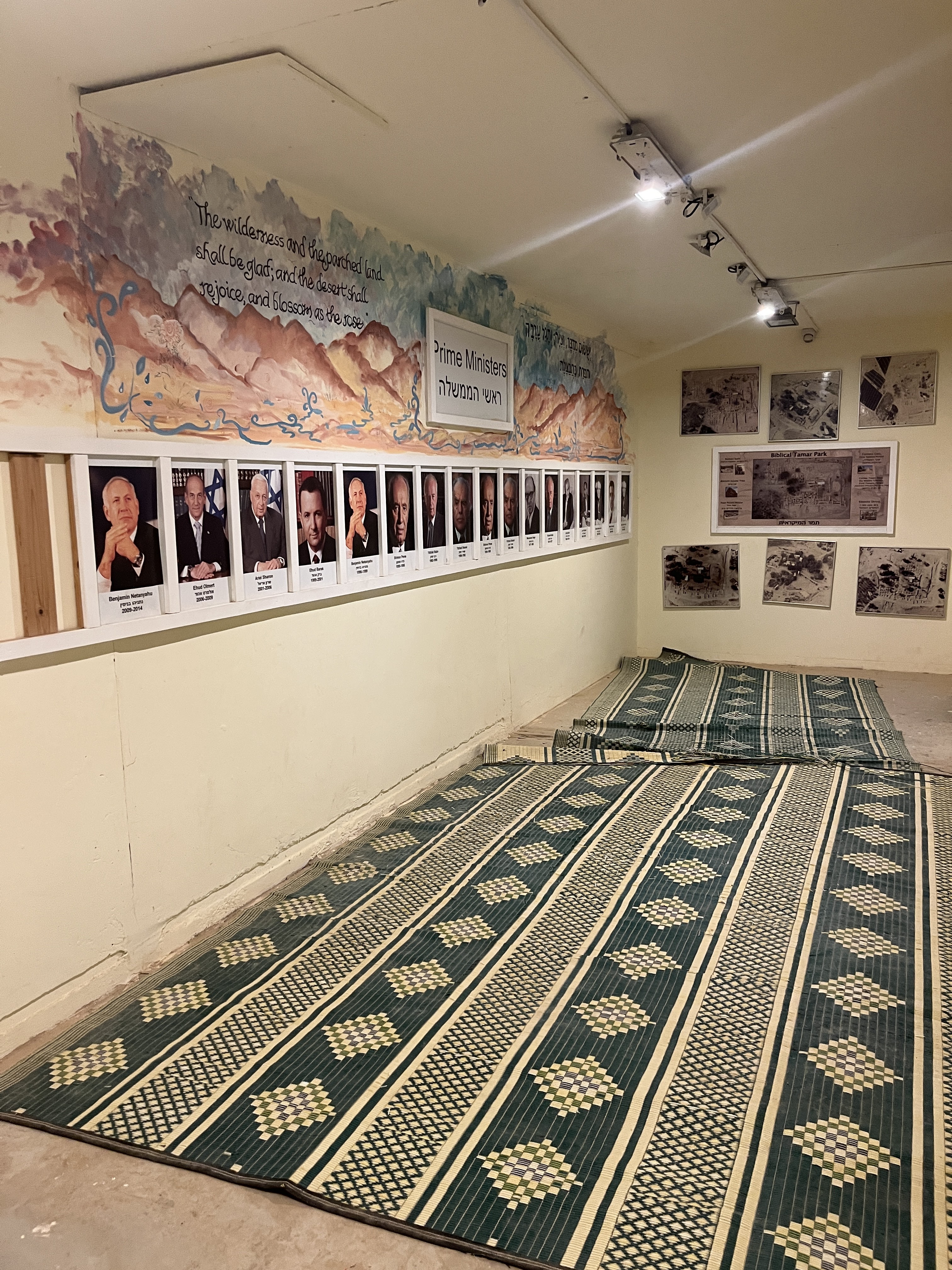
Anyway, you can go into the police station and the underground bunker. There are photos on the walls of all of the Prime Ministers and Presidents in the bunkers, and the police station has photos and information of important Israelis and others who aided in the rebirth of Israel in the Land.

I love how light glows through the open back door of the bunker in the photo above!


Wow, what an amazing history in this place!

One more thing to feature in this blog, because it's pretty cool. According to BibleWalks*, this is the oldest tree in all of Israel. Wow! It is somewhere between 1500-2000 years old, and has survived this long because of the spring of En Hazeva! Wow! I saw the tree, but in photos it looked like a mess (and I didn't see a sign near it), so I am posting their picture below:

This tree would have been there during the Roman era! Wow!

I definitely recommend visiting Tamar park if you get a chance. It's beautiful, and it's free to walk explore the archeological park.


*I didn't have a tour and the only brochure I saw was in Hebrew, so all the information I learned about Tamar Park is from Bible Walks.

Sunday, May 22, 2022

The Red-Haired Archaeologist Digs Israel

Right before coming to Israel, I found this short, quick read by Amanda Hope Haley: The Red-Haired Archeologist Digs Israel.


Written by (you guessed it!) a red-haired archeologist, it's more a story of the time after she attended a dig in Israel, when her family came to visit and they explored this beautiful land for a few more weeks than it is about her adventures digging (although there is that at the beginning). So for me, it was a review of many of the places I've been, seen through the eyes of an American archaeologist—which was fun! 

Haley's attention to detail was strong here, as she noted small events that happened in each city during her visit, from someone's expression to the food they ate. And I totally get why she wrote this, because I created my own photo album after I came, completed with written explanations, because I wanted to personally re-live my own trip and never forget those tiny details. So it was fun to go through this travelogue with her and her family.

If you want to know more in general about a lot of famous sites in Israel, then this is a great, quick read from someone who loves history and sharing it with others. 

Click here or on the image above to find it on Amazon!


Monday, October 4, 2021

The Rock, the Road, and the Rabbi: The Dead Sea Coming back to Life!

This is the last post from the series on The Rock, the Road, and the Rabbi. I hope you've enjoyed it as much as I have!


This last post is going to talk about the Dead Sea, and something incredible discovered in 2011. Actually called the Salt Sea, it was nicknamed the Dead Sea because nothing can live in it. The water is about 10x more mineral than an ocean, which means that you can float in it. It's literally impossible to drown. If you walk far enough out, your feet will just fly out from under you (this happened to me) and you will float. It's so trippy! At 2000 feet below sea level, it's the lowest place on earth, and believed to be the site of Biblical Sodom and Gomorrah. It's also evaporating at the rate of 1 meter a year. 

Many years ago, a tourist noticed freshwater pools along the shores of the Dead Sea with fish swimming in them! WOW! And then somehow they figured out how to explore the bottom in 2011 and discovered "huge craters on the seafloor, fifteen meters across and 20 meters deep, full of fresh fish and covered with mats full of microorganisms, with freshwater flowing from the craters" (page 165)!

WOW! This is especially incredible to me in light of Ezekiel's words about what will happen in the Millennial Kingdom

"He asked me, 'Son of man, do you see this?'

Then he led me back to the bank of the river. When I arrived there, I saw a great number of trees on each side of the river. He said to me, 'This water flows toward the eastern region and goes down into the Arabah, where it enters the Dead Sea. When it empties into the sea, the salty water there becomes fresh. Swarms of living creatures will live wherever the river flows. There will be large numbers of fish, because this water flows there and makes the salt water fresh; so where the river flows everything will live. Fishermen will stand along the shore; from En Gedi to En Eglaim there will be places for spreading nets. The fish will be of many kinds—like the fish of the Mediterranean Sea. But the swamps and marshes will not become fresh; they will be left for salt. Fruit trees of all kinds will grow on both banks of the river. Their leaves will not wither, nor will their fruit fail. Every month they will bear fruit, because the water from the sanctuary flows to them. Their fruit will serve for food and their leaves for healing'” (Ezekiel 47: 6-12)

SO COOL! This is what's coming—but it's already happening!

I hope this series encourages you to get this book (click on the picture below to get it on Amazon, or click here). Have you guessed the meaning of the title yet? The Rock is the Jesus, the Road is the Holy Land, and the Rabbi is the Word of God.

What did you think of this series? Let me know in the comments below!

Monday, September 27, 2021

The Rock, The Road, and The Rabbi: Faith as a Mustard Seed

This is probably my favorite scene from The Rock, The Road, and the Rabbi.


Kathie Lee Gifford depicted a scene on top the Mount of Olives, which I can see clearly in my mind's eye. I remember being there. But her guide, Ray Vander Laan, took her to a specific place I didn't go. She describes her group being told to sit very specifically in front of some overgrown bushes, looking out over a beautiful view. Then Ray told the group that those were mustard plants, "the most feared plant in all of Israel [....] It's feared because once it takes root, it can't be destroyed. You can try to burn it, stomp it out, tear it out, but eventually, it takes everything in its way" (page 110).

All of this from the tiniest of seeds—and Jesus compares the mustard seed to the Kingdom of God! In fact, Jesus said, “Because you have so little faith. Truly I tell you, if you have faith like a grain of mustard seed, you can say to this mountain, 'Move from here to there,' and it will move. Nothing will be impossible for you” (Matthew 17:20).

That's when Gifford says Ray pointed at the Herodium in the distance, quoting the verse above. The Herodium is one of Herod's 11 palaces, and the place he was buried. It symbolizes the evil and opulence found in this world, and the hardship the Jewish people found at Herod's hands. Then, Ray pointed in the other direction, in which the Dead Sea was clearly visible! This is the only place on the Mount of Olives on the where you can see mustard plants, the Herodium, and the Dead Sea—which means Jesus was standing in that very spot when He said those verses!

Ray said, "The kingdom of God is us! It is all of us as believers. If we just believe, we can say to that mountain—the world's way, Herod's way, Satan's way—be gone, into that sea, the Dead Sea, which is already dead!"

WOW!!!

Definitely another #micdrop moment!

Monday, September 6, 2021

The Rock, The Road, and the Rabbi: Mic drop!

I loved reading Kathie Lee Gifford's The Rock, the Road, and the Rabbi, probably because it reminded me of my trip to Israel in 2017. 

She went to a lot of places I went to, so I could see them in my mind's eye—but her tour guide was Ray Vander Laan, whose videos with Focus on the Family are incredible. I've heard there's a 3-year wait to get on one of his tours (probably longer now thanks to covid-19), but it's always good to dream. 

This book is an easy read, as each short chapter focuses on a different location, and then Rabbi Jason Sobel (pictured on the cover) often adds to the commentary. So I'm going to make this a series, because there were so many good things I picked up on in this book.


Here's some good stuff just from the opening chapters:

"All of Scripture is meant to point to the Messiah in some way. For example, as Rabbi Jason explained to me, the first letter of Genesis is the Hebrew letter bet, and the last word of the book of Revelation is the Hebrew word amen, which ends in the letter nun. The first and last letters of the Bible spell the Hebrew word Ben, which means 'Son'. From the very first to the very last letter, everything in the Bible points to the Son!" (page 5). This really struck me, because I am currently learning Hebrew, and of course, I started with the alphabet. How amazing! I love how things are hidden in Scripture like this!

Later, on page 8, Gifford describes her first few hours in the Holy Land, following guide Ray Vander Laan up a mountain to reach Gezer, an ancient Biblical city overlooking the Via Maris (the ancient trading road that ran alongside the Mediterranean Sea). Ray explained, "The problem with the Bible [...] is that the Bible was written by Middle Easterners for Middle Easterners. But we try to understand it with a Western mindset. We try to apply our own principles and our Western understanding to a culture that is completely foreign to us". As they gazed down on this road from above and saw how it connected the ancient world as nothing else could, the lesson hit home (described on page 10). 

Then, the commentary changes and Rabbi Jason Sobel adds his thoughts, and it is like the biggest mic drop of all:

"Israel's geographic position is key, since it functions as a land bridge between Asia and Africa. But from a spiritual perspective, there is even more. I believe the land God promised Abraham has the same geographic boundaries as the garden of Eden" (page 10). 

WHAT???

I've heard that it could be in Bahrain, or even Saudi Arabia. But Israel itself being the Garden? WHOA! That's especially interesting to me because as Ezekiel 36-37 predicted, the Land has come back to life in recent decades. The very desert is blooming—which is spoken of in Scripture. And later in Ezekiel, it talks about the Millennial Kingdom and how a river will flow out from the Temple Mount, in one direction to the Mediterranean and in the other, to the Dead Sea. It says that the Dead Sea will fill with life. Could Israel really be the setting for the Garden of Eden?

What do you think? Let me know in the comments below!

Wednesday, March 17, 2021

Shocking news from Israel!

Yesterday, I saw 3 SHOCKING stories come from Israel. Are you ready for this?


WOW! 

I'm still in shock over the 4 that happened, and there might be 4 more peace deals between Israel and Arab nations on the way! Based on this op-ed in the Wall Street Journal, I'm going to guess: Saudi Arabia, Qatar, Oman, and Mauritania. WOW! WOW! And I don't think these will be brokered by another nation, which is even more astounding! I am definitely going to stay tuned for this!

Here's the 2nd story that caught my attention. Because I LOVE archeology, I definitely dorked out over it:


In the "Cave of Horror" in the Judean Desert, which earned that name because the only way to enter is by repelling 80 meters down (263 feet!) from a cliff into it, they found 2000-year-old Biblical texts (the first since finding the Dead Sea Scrolls!), a basket dating back 10,000 years, coins also almost 2,000 years old, and the skeleton a child dating back 6,000 years. 

  • Of the scroll fragments, the article states: "The scroll was written in Greek, but God’s name appears in paleo-Hebrew. It contains passages from the Minor Prophets, including Nahum." This is the first find since the Dead Sea Scrolls!
  • Of the basket, it says, this is said to be "a 10,000-year-old exceptionally well-preserved basket which experts say might be the earliest item of this kind ever uncovered." I don't quite understand this, as the earth is only about 6,000 years old. But the dating of the coins and scroll fragments is unmistakeable.
  • The coins date back to the Bar Kochba Revolt in 70 AD.
  • Of the mummy, he or she was so well preserved because of the desert conditions but also by his or her wrapping and burial. To me, this is evidence of how loved he or she was. And while it is heartbreaking to read and imagine, that is comforting.


And for the 3rd story... this isn't so much shocking as good news, it looks like Israel might be the first nation to emerge into a post-Covid world. They are even talking of opening up tourism in April!


What do you think of these 3 amazing stories from Israel? Let me know in the comments below!

Monday, March 8, 2021

2000-year-old tree bears fruit—for the first time!

Remember this story?

Well, Methuselah's story isn't over!


According to this February 27, article from Behold Israel, Methuselah, who was in fact a 'male' tree and cannot produce fruit. However, 6 more seeds were painstakingly revived and were given the names Adam, Jonah, Uriel, Boaz, Judith, and Hannah. Then, Methuselah was used to cross-germinate Hannah, and the result was...

111 dates!

Which means, that these dates are as close as we can get to tasting what a 1st century person did when eating from a date palm. It's still different because of so many factors, like soil quality, air quality, etc. But still, can you imagine? This is what Jesus and the disciples would have tasted in the desert.

WOW! 

The stories that seed could tell...