Showing posts with label Beit She'an. Show all posts

Sunday, April 23, 2023

Can a nation be built in a day?

Isaiah 66:8 asks the impossible question: "Can a country be born in a day, or a nation be brought forth in a moment?"

On May 14, 1948, that's what happened when the nation of Israel was re-born in the Land.

While definitely the most clear example, that's not the only way this impossible question was answered by the rebirth of Israel. 


Beside Gan HaShlosha is the park of Tel Amal, which is an exact replica of the first Stockade and Tower Settlement of Tel Amal, which was built December 1936.

According to this site, Tel Amal was the first settlement of its kind. It was literally raised in a day, and became a model for 57 other settlements throughout Israel between 1936-1939.


The element of surprise was crucial, so that they couldn't be stopped. Everything was pre-fabricated and then constructed on-site in 1 day. The walls were filled with gravel that would stop bullets. And you can see from the map above, that these literally helped form the modern boundaries of Israel, as they were built along the borders, in Jewish areas.

Today, at Tel Amal, you can tour the settlement. Visitors go on a journey with characters in a film (based on the original settlers) as they prepare and then build the settlement.


Then, you can walk around and see:

The living quarters
The office
kitchen/laundry


You can also climb the tower and look around. It's an incredible view, with the kibbutz Nir David and the Amal stream on one side, Gan HaShlosha on another, and Mount Gilboa alongside.


Finally, have you ever heard the term, "Sabra"? It's the fruit of a cactus, and is a nation for Israelis who were born in the Land. It's hard and spiny on the outisde, but the inside is sweet. Here is some sabra growing alongside Tel Amal.

What do you think? Is this an additional meaning to the question if a nation can be born in a day? While I believe it was pointing to May 14, 1948, how amazing that these settlements literally went up on a day and formed the boundaries of modern day Israel? I definitely see a connection there as well!


Monday, March 20, 2023

An oasis near Mount Gilboa

About 10 minutes from Mount Gilboa, where Saul fell in battle, is one of the coolest natural parks I've seen in Israel.

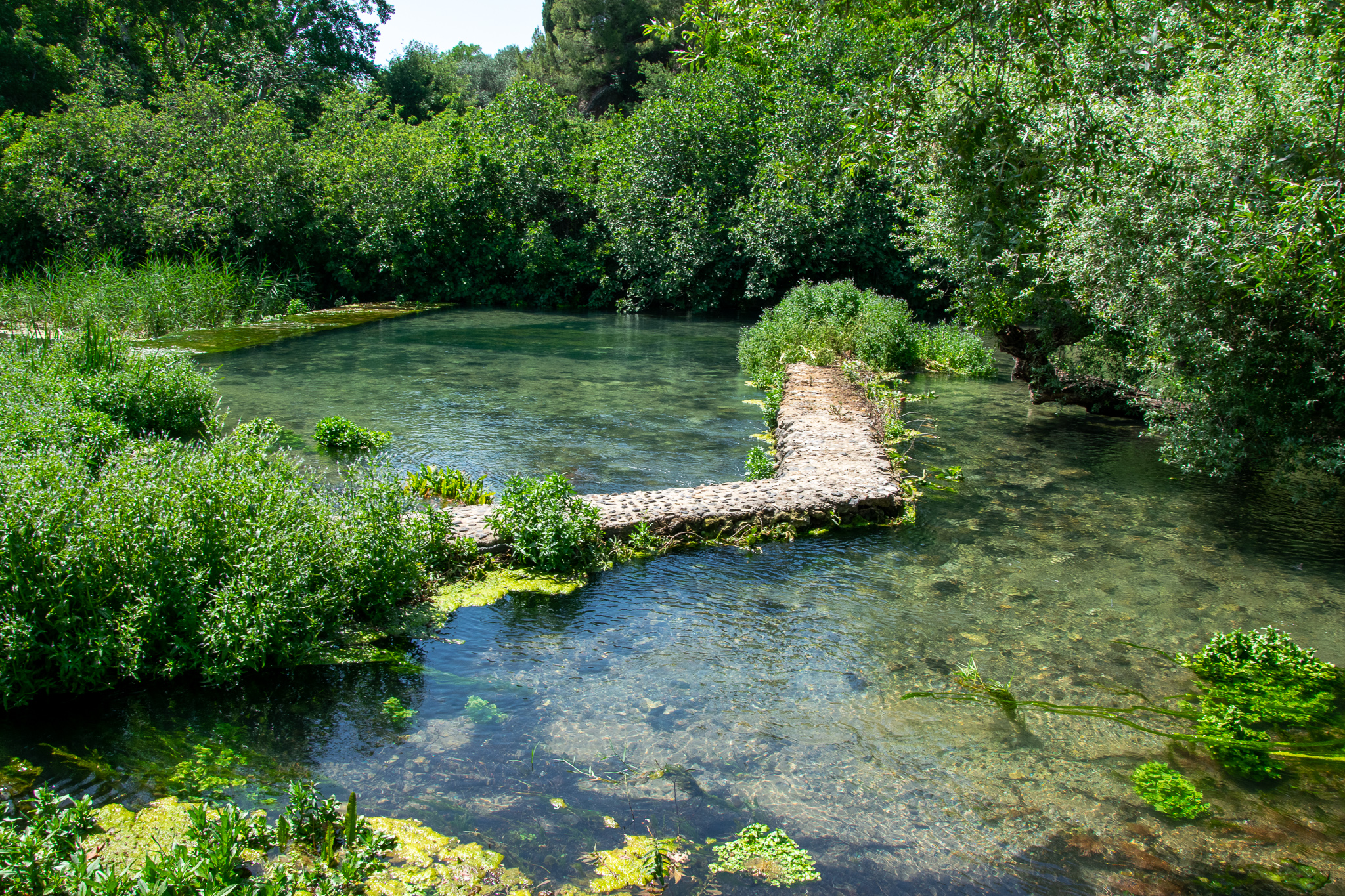
Fed by the Amal stream, Gan HaShlosha is an incredible oasis on a hot day. It stays at a constant 28 degrees celsius, or 82 degrees Fahrenheit, so it is even swim-able in the winter.


On a hot Friday in August, it felt like paradise. Surrounded by grass (GRASS!! still green!) and trees swaying in the wind, practically in the shadow of the mountain cursed by David after Saul’s death, these natural pools are an amazing place to explore- and cool off!

I can understand why a movie called "Garden of Eden" was filmed here... just be ready for some fish to nibble at your ankles!


Monday, October 24, 2022

The last thing I expected to see at Caesarea Philippi

Caesarea Philippi is known for being the place in Matthew 16 where Peter says to Jesus, "You are the Christ (Messiah), the Son of the Living God".

In this region is this mountain and cave where the headwaters of the Hermon Stream (from Mount Hermon) flow out of the ground and form part of the headwaters of the Jordan River. 


What I learned on this visit there, that differs from my tour in 2017, is that while Peter said this to Jesus in this area, it's unlikely he said it right here at this cave. 

Why?

Because it's a place of pagan idolatry, and Jews would not have gone there. Jesus didn't need to—everyone know about this place, this rock. His play on words, "Upon this rock I will build my church" still makes sense whether or not Jesus was standing there. 

While today the cave is closed up (though still deep), back in the day, this is where the water flowed from—just like the spring where Gideon's men drank. It's was so deep they couldn't find the bottom, and it was believed that this was the gate to the underworld.

Next to this cave were temples to the pagan god Pan. People worshipped here, did vile acts, and sacrifices were made in this stream. This site says that children were thrown in; we know for a fact that goats were too. If the goats sank, then the sacrifice was accepted.

In 749 AD, the same earthquake that destroyed Beit She'an, Susita, and so many other places in Israel, also destroyed this place. At that point, the cave was closed in and the springs found a place farther south to stream from the rock.

The last time I visited this site, this is basically all I saw, along with more statues/pillars. So I was unprepared for the latest excavations:


It turns out that Augustus Caesar gave this town to Herod, who turned around and built a marble temple for Caesar in front of the cave. About 5 centuries later, a church was built right over those ruins.


Something that is very common in Israel that is that any place where it's documented that Jesus said or did something, the Catholic, Greek Orthodox, or another liturgical church came later and built a church there. So, I guess it shouldn't be that surprising—but I was only here 5 years ago and those ruins had not been excavated then! So that definitely shocked me.

It's also surprising to me, to see a church here at a place of pagan worship, even if Jesus did say that statement nearby (or right there). But, there you go... can't argue with proven fact. 

What do you think of this?

Sunday, September 25, 2022

Mount Gilboa: Where King Saul died

And now we've come to Mount Gilboa, where Saul, Israel's first king, and his sons died. 


Or rather, the view from this mountain. It's likely Saul and his sons were killed closer to the base of it. And then, of course, their headless bodies were carried back to Beit She'an and hung from the city gates (of the town on top of the tel).


Do you remember why this mountain is barren?


In 2 Samuel 1, David cursed it for being the place where Israel's first king died. More than 3 millennia later, except for a patch where the Jewish National Fund planted some trees, the mountain is still bare.


Now, it's a place for people to come and hang out, picnic, and even hang glide over the Jezreel Valley. There are kibbutzim at the base of it, and hiking trails up to the place called "Saul's Shoulder".

WOW! Definitely a surreal place to visit in the Jezreel Valley.

Monday, September 5, 2022

Beit She'an: Trapped in Time

Beit She’an is one of those places that I knew was cool when I visited in 2017, but was unable to fully grasp just how incredible it was. I think I was on overload at the time.

So when I went back, I got to be amazed all over again!


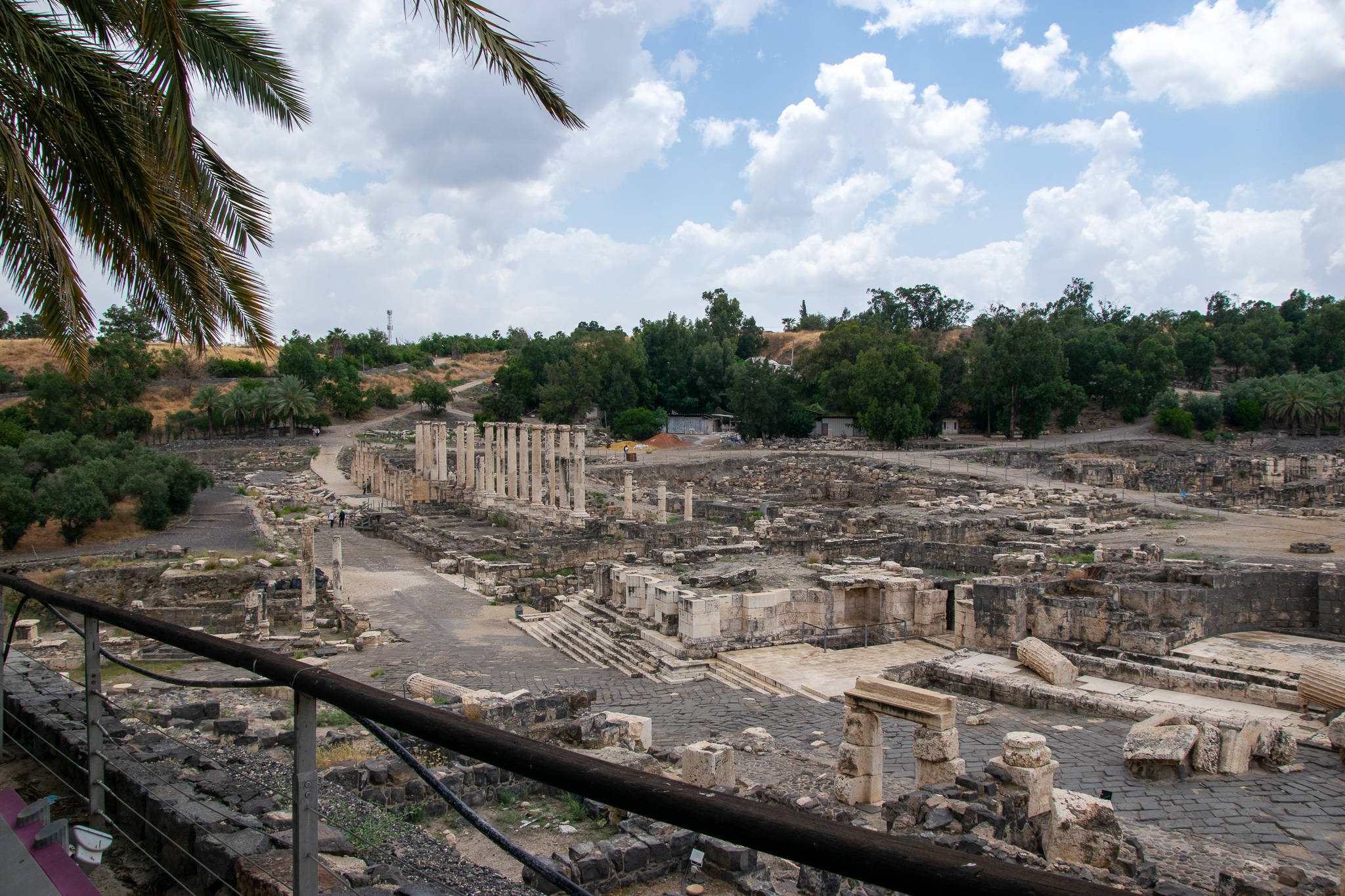
One of the 2 cities of the Decapolis as mentioned in the NT that is in Israel (the other being Susita in the Galilee), Beit She’an was a thriving Roman city during Jesus’ day. It was built at the foot of a tel dating back millennia- the same place where the Philistines hung the headless bodies of King Saul and his sons over the walls (1 Samuel 31:8-13). From a theater to a bathhouse and public toilets, this place had it all.

The bathhouse:


View from the main street (cardo):

The cardo, or the main street going through the center of town:


The statues here show at least 1 thing this city was known for...


Until 749 AD, when a massive earthquake shook the entire region- the largest in recorded history. All this splendor fell down and cracked open, stately columns rolling this way and that until they finally stopped laid in testament to the tectonic game of pick-up sticks the earth played on that fateful day. When the city was found and excavated, coins dating to 749 AD were found, marking the exact date of destruction almost as well as a stopped clock.


These columns are massive... grown men can't wrap their arms around them.


Once again, I went up to the top of the tel. The view was stunning!


On a clear day, you can see all the way into Jordan from the other side:


At the top of the tel lie more ruins, this time of the Philistine village. But, they dug deeper and even found the governor’s house from when the Egyptians controlled the area! That’s MILENNIA ago!


WOW! If you ever get a chance to visit Beit She'an, I highly recommend it! The magnitude of it is overwhelming.

Sunday, February 6, 2022

Hippos took my breath away

After Jesus sent the demons into the pigs in the Galilee in Mark 5, He told the formerly demon-possessed man to go far away instead of going home. This is because the people who lived nearby were afraid and angry. Mark says that the man went to the Decapolis, which I assumed was Beit She'an. When I went to Kursi National Park and saw the cliff, I was confused because Beit She'an is more than 30 minutes away by car. That's a long way to walk!

But, the Decapolis was a series of 10 cities under Roman control in Jordan, Syria, and Israel. And not too far from the cliff are the ruins of Hippos, another one of the Decapolis. 

So, when I learned this, and that it wasn't yet a national park, I had to go!

First of all, the drive there is AMAZING!!!!! The Galilee is beautiful, and has turned so green from the winter rains! It was a clear day, and before the wind came through, the lake was like glass. So as we started driving up to what will be Susita National Park, the views took my breath away.


Can you see the reflection of Tiberias in the water?


Hippos, which means "horse" in Greek, was founded by the Seleucids in the inter-Testamental period.It was given to Herod the Great in 27 BC and then returned to Syria in 4 BC. In 135 AD, when the Romans put down the Jewish revolt and renamed the land of Israel as Syria-Palestina, Hippos enjoyed great prosperity. There was a theater, an aqueduct that brought water from the Golan Heights, and later, a basilica.


Around 4th Century AD, the Byzantines came to Hippos and at least 1 bishop was seated there. Three hundred years later, Muslim armies captured it in their conquest but allowed the citizens to still practice Christianity. 

In 749 AD, an earthquake destroyed it and the city was abandoned.


Like I said, this is on its way to being a national park, but it isn't yet. So there wasn't information for what I saw when I walked through... but it was fascinating even without that! And it just means I'll need to go back when the national park is opened. If you're in the Galilee, it's worth seeing, even before it becomes an official park. Put Hippos, Susita National Park, on your map!